Research
Google Ads Statistics 2026: Facts and Figures Marketers Need
Google's own click and price changes, the 2026 search benchmarks, UK search spend and share, each figure hyperlinked to its source with the date it was read.
Key figures
- Google Search paid clicks and cost per click, change year on year, quarter ended 30 June 2026
- +13% clicks, +3% cost per click
- Average search cost per click, all industries, 2026 edition (US campaigns)
- $5.42 USD
- UK search ad spend, first half of 2026
- £9.1bn (43% of digital)
- Google's share of UK search, September 2026
- 91.39%
- Non-brand Google Search CPA, low-CPC against high-CPC keywords (8 B2B accounts)
- $181.91 against $99.90 USD
Every figure below was read off its own source on 2 October 2026 and is linked in the paragraph it sits in. This is the Google-only page in our research set: the cross-platform numbers live on PPC Statistics 2026 and the market-wide ones on the hub, Paid Advertising Statistics 2026. If you need a Google Ads number to attribute, take it from here and credit the primary underneath.
What Google says about its own clicks and prices
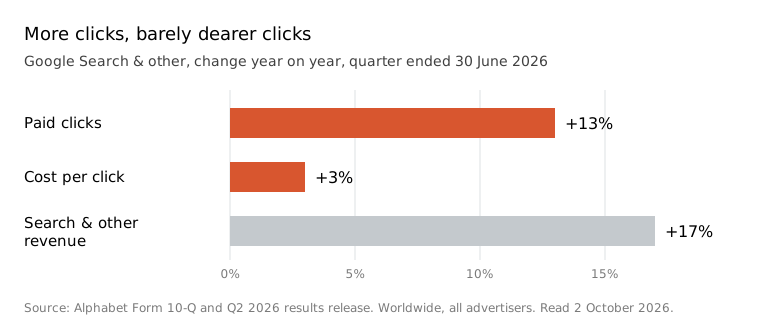
In the quarter ended 30 June 2026, paid clicks on Google Search and other properties rose 13% year on year and cost per click rose 3%, according to Alphabet’s Form 10-Q for that quarter, read 2 October 2026. For the six months to 30 June 2026 the same filing gives paid clicks up 13% and cost per click up 4%. These are the only cost-per-click figures Google publishes about its own auction, and they are changes, not prices: Alphabet does not disclose an average cost per click in any currency.
Read the definitions before you quote them. The same 10-Q counts paid clicks on Google search properties and other Google-owned properties including Gmail, Google Maps and Google Play, and defines cost per click as click-driven revenue divided by total paid clicks. That makes it a worldwide average across every advertiser, not the price of your keyword, and the filing adds that Alphabet periodically reviews and refines how it counts paid clicks.
On the display side, the filing gives Google Network impressions down 12% and cost per impression up 13% for the same quarter. That is a different story from search; keep the two apart.
How Google’s search quarter adds up
Google Search and other revenue was $63,271m USD in the quarter ended 30 June 2026, against $54,190m USD a year earlier, and Google advertising in total was $81,629m USD, per Alphabet’s second quarter 2026 results, dated 22 July 2026 and read 2 October 2026. The release puts Search and other growth at 17%.
The click metrics nearly explain that on their own. Derived by us on 2 October 2026 from the 10-Q: 1.13 (paid clicks) multiplied by 1.03 (cost per click) is 1.1639, an implied 16.4% increase, against the 17% Alphabet reported. The small gap is expected, because both inputs are rounded to whole percentages and Search and other includes revenue that is not click-driven. The implied figure is ours and it is arithmetic, not a measurement.
Search and other is 77.5% of Google’s advertising revenue. That is also derived: $63,271m divided by $81,629m is 0.7751, worked out on 2 October 2026 from the supplemental table in the results release. Alphabet does not publish the share itself.
The 2026 search benchmarks, and whose campaigns they are
Across industries, the 2026 averages for search advertising are a cost per click of $5.42 USD, a click-through rate of 6.64%, a conversion rate of 8.18% and a cost per lead of $66.69 USD, published by WordStream by LocaliQ, last updated 1 June 2026 and read 2 October 2026. The WordStream benchmarks index, read the same day, says the edition covers over 13,000 US-based campaigns running from April 2025 through March 2026.
Three cautions travel with those numbers. WordStream and LocaliQ are one company publishing one dataset, so a roundup citing both is citing one source twice. The campaigns are that company’s own customers, and the LocaliQ page says they span Google Ads and Microsoft Ads, even where it labels a figure as the Google Ads average. And every figure is in US dollars from US campaigns; none is converted here, because a UK auction is not a US auction with a different currency symbol.
Year on year, the index page gives the 2025 edition’s average cost per click as $5.26 USD, from over 16,000 US-based campaigns running April 2024 to March 2025. Derived by us on 2 October 2026: $5.42 divided by $5.26 is 1.0304, a 3.0% rise. That sits neatly beside Alphabet’s 3% cost-per-click change, but they are different measures: one is a vendor panel whose sample shrank between editions, the other is Google’s worldwide click revenue divided by its clicks. Two numbers that happen to agree are not one number confirming the other.
The spread by industry
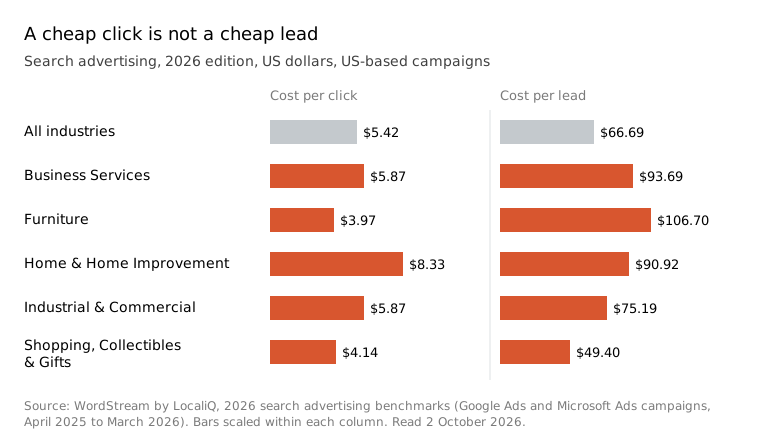
The average hides a spread that matters more. On the same LocaliQ page, read 2 October 2026, Business Services pays $5.87 USD a click and $93.69 USD a lead at a 4.85% conversion rate, Furniture pays $3.97 USD a click but $106.70 USD a lead at 2.99%, and Home and Home Improvement pays $8.33 USD a click and $90.92 USD a lead at 8.05%. Industrial and Commercial sits at $5.87 USD a click and $75.19 USD a lead, and Shopping, Collectibles and Gifts at $4.14 USD and $49.40 USD.
Furniture is the cleanest illustration of why cost per click makes a poor target: one of the cheapest clicks in the table buys one of the dearest leads, because fewer of those clicks convert. For a furniture retailer a lead is an odd unit anyway, since the conversion that pays the bills is an order, which these benchmarks do not measure. The same page says cost per lead fell across all industries for the first time in five years, which is the vendor’s reading of its own panel.
What UK advertisers spend on search, and where they search
UK search advertising reached £9.1bn in the first half of 2026, 43% of a £21.2bn digital market, with search growing 10% against 13% for digital overall, according to IAB UK and mediasense’s Digital Adspend HY 2026, published 29 September 2026 and read 2 October 2026. Search is still the largest UK digital channel by some distance; it is simply growing more slowly than retail media, up 32% to £2.0bn, and video, up 18% to £5.1bn.
Be careful comparing editions. The 2025 full-year release says IAB UK moved to an updated methodology from HY 2025 and that the new data cannot be reconciled with editions released before it, and the HY 2026 release names a different research partner. Quote the growth rates each release states rather than subtracting one edition from another.
Google’s share of UK search was 91.39% in September 2026, with Bing at 6.08%, per Statcounter Global Stats, read 2 October 2026. Statcounter describes the chart as based on over 3 billion monthly page views, which makes it a measure of search use, not of advertising spend.
So there is no UK figure for Google Ads spend on this page, and that is deliberate. Multiplying IAB UK’s £9.1bn by Statcounter’s 91.39% would look precise and mean nothing: one counts page views, the other counts money across every search seller, and nobody publishes the Google slice of UK search spend.
Google’s numbers about Google
Google says it blocked or removed over 8.3 billion ads and suspended 24.9 million accounts in 2025, including 602 million ads and 4 million accounts associated with scams, in its 2025 Ads Safety Report announcement, dated 16 April 2026 and read 2 October 2026. The same post says its systems caught over 99% of policy-violating ads before they served, and that incorrect advertiser suspensions fell by 80%. Every one of those is Google reporting on its own enforcement, with no independent audit on the page.
Google’s Economic Impact site, read 2 October 2026, says Google Search, Google Play, Google Cloud, YouTube and its advertising tools helped provide $947 billion USD of economic activity for American businesses, nonprofits, publishers, creators and developers in 2025. That is Google’s own estimate of value it says it created. It is a United States figure, it bundles free products with paid advertising, and it is not a return on ad spend, so it should never be quoted as a UK number or as what an advertiser earns per pound.
What a cheap click actually costs on Google Search
Our own research looked at eight B2B accounts and about $2.67m of Google Search spend over two years. Non-brand cost per acquisition was $181.91 on low-CPC keywords against $99.90 on high-CPC keywords (45% lower), and brand CPA was $25.76 against $147.09 (471% higher). The method is in Stop Chasing Cheap Clicks: Snowball Creations client data, 8 accounts, two years, figures in US dollars.
It is the same lesson as the Furniture row above, measured inside real accounts rather than across a panel. In those accounts the cheapest non-brand clicks produced the dearest acquisitions, so an account steered towards a lower average cost per click would have been steered away from the money.
Method
Every figure on this page was read off its own source on 2 October 2026 and linked where it appears. Three are derived, and each shows its working in place: the implied Search and other growth from Alphabet’s 10-Q, the Search share of Google advertising from Alphabet’s results release, and the year-on-year change in the panel’s cost per click from the WordStream index. Nothing was carried over from the January 2026 version of this page, which attributed its figures in plain text to aggregators; anything we could not trace to a primary today was dropped.
Claims are labelled as claims. WordStream and LocaliQ are one company and one dataset, and its panel mixes Google and Microsoft campaigns. The Ads Safety figures and the Economic Impact estimate are Google describing itself. Statcounter measures page views, not spend. Money stays in the currency its source used, with no conversion anywhere on the page.
This page is maintained: it is rolled every January and re-read when Alphabet files a new quarter or a source publishes a new edition. It replaces our January 2026 Google Ads statistics post and sits under the hub, Paid Advertising Statistics 2026.
What this means if you are running Google Ads
Google is selling more clicks at a slightly higher price, which means the auction is not getting cheaper and the advertisers who win are the ones who know which clicks turn into customers. If you would like someone to look at yours, we run Google Ads for B2B, SaaS and homeware brands, and you can get in touch.
FAQ
Questions people ask
Does Google publish an average cost per click in pounds or dollars?
No. Alphabet's filings give the percentage change in cost per click each quarter, worldwide and across all advertisers, but never a price. Any average cost per click you see in currency comes from a third party's panel, and the one on this page is labelled with whose panel it is.
Is there a UK cost per click benchmark for Google Ads?
Not one we could read off a primary source with its sample stated. The benchmarks most pages quote, including the ones here, come from US-based campaigns. The UK figures on this page are spend and search share, in pounds and percentages, from IAB UK and Statcounter.
What happened to the statistics in the January 2026 version of this page?
Most of them were attributed in plain text to aggregators rather than to a primary source. Every figure was re-read for this rebuild, and anything we could not trace to its original publisher on the day was dropped rather than refreshed.
Sources
- 1. Alphabet, Form 10-Q for the quarter ended 30 June 2026 Read 2026-10-02
- 2. Alphabet, second quarter 2026 results Read 2026-10-02
- 3. WordStream by LocaliQ, search advertising benchmarks 2026 Read 2026-10-02
- 4. WordStream by LocaliQ, PPC benchmarks index (samples and prior editions) Read 2026-10-02
- 5. IAB UK and mediasense, Digital Adspend HY 2026 Read 2026-10-02
- 6. IAB UK, Digital Adspend 2025 (methodology note) Read 2026-10-02
- 7. Statcounter Global Stats, search engine market share, United Kingdom Read 2026-10-02
- 8. Google, 2025 Ads Safety Report announcement Read 2026-10-02
- 9. Google Economic Impact (United States) Read 2026-10-02
- 10. Snowball Creations, Stop Chasing Cheap Clicks (first-party, 8 B2B accounts) Read 2026-10-02
Cite this page
Free to quote with a link back. Figures were last checked on 2 October 2026.
Snowball Creations, "Google Ads Statistics 2026: Facts and Figures Marketers Need", 2026. https://snowballcreations.com/research/google-ads-statistics/
A plain-text version for AI tools and reference managers: /research/google-ads-statistics.md