Trying to find the balance between tightening spend and scaling your SaaS can feel like herding cats during a fire drill (impossible and f***ing stressful).
Between Cost Per Acquisition (CPA), Customer Acquisition Costs (CAC), churn rates, and return on investment (ROI), it’s easy to get caught up in the chaos of short-term metrics and lose sight of the bigger picture, profitability over time.
That’s where Customer Lifetime Value (CLV) comes in. CLV helps you step back from daily fluctuations to see how much each customer is truly worth throughout their relationship with your business.
What Is Customer Lifetime Value?
Here’s the gist: Customer lifetime value is the total revenue you can expect from your average customer throughout their entire relationship with your business. CLV is typically calculated as an average across your whole customer base, rather than for one individual customer.
CLV tells you how much you can afford to spend to acquire new customers, and whether spending more would be a profitable move.
Think about it this way, you sell software at £50/month. Customer A churns after 3 months (£150 total). Customer B sticks around for 2 years (£1,200 total). If you’re paying £200 to acquire each customer through Google Ads, one of these customers is a disaster, and the other’s a dream. But if you’re only looking at first-month revenue, they look the same.
As well as being an important metric for assessing profitability, LTV can help guide your paid advertising strategy. It reveals which types of customers deliver the most long-term value, providing insights that help you allocate your budget more effectively and refine your targeting.
How is Customer Lifetime Value (CLV) Calculated?
In eCommerce, the formula is based on purchase frequency as well as the length of time they continue purchasing.
CLV formula for eCommerce: (Average Purchase Value) × (Average Purchase Frequency) × (Average Customer Lifespan)
In SaaS, it’s defined by recurring revenue metrics, specifically, ARPU, Gross Margin, and Churn Rate. Understanding how to calculate customer lifetime value using these metrics helps you see how long customers stay and how much profit they generate over their lifecycle:
ARPU (Average Revenue Per User): how much each customer pays on average per month.
Gross Margin: how much profit you retain after the costs of delivering your product or service (not including marketing or acquisition costs).
Churn Rate: Measures the rate of cancellations, usually expressed as a percentage. From this, you can estimate your average customer lifespan.
See whether your marketing spend is driving sustainable growth or just short-term wins.
Know exactly how much you can afford to spend to acquire new customers while staying profitable.
Identify channels and customer segments that deliver the best long-term return.
Confidently increase spend once your ratio hits a healthy threshold.
- 1) Define your cohorts:
Segment customers by acquisition month, channel, or plan type. 2) Gather your data:
For each cohort, collect retention, ARPU, and CAC data.3) Calculate LTV and CAC per cohort:
Determine the lifetime value and acquisition cost for each group.4) Find the ratio:
Divide LTV by CAC to see how efficiently each cohort converts spend into profit.5) Analyse the results:
Compare ratios to spot trends. Example: A Q2 cohort might show a 5:1 ratio versus 3:1 in Q1 due to better onboarding or higher ARPU.6) Optimise and act:
Double down on high-performing channels or cohorts and adjust budgets to fuel sustainable growth.
CLV formula for SaaS: (Average Revenue Per User × Gross Margin) ÷ Churn Rate
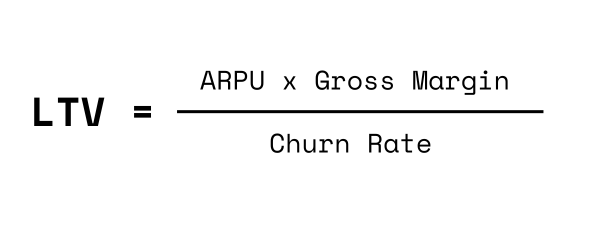
How to calculate Customer lifetime value example:
If your ARPU is £80/month, gross margin is 80%, and churn is 5%, your CLV would be:

CLV to CAC Ratio Formula, and Why It Matters
CLV on its own doesn’t tell you much about long-term profitability, but when you pair it with Customer Acquisition Cost (CAC), it reveals whether your growth is truly sustainable.
For a SaaS company to grow sustainably, the cost of acquiring a new customer, the Customer Acquisition Cost (CAC) should always be lower than the Customer Lifetime Value (CLV) of that same customer.
For example, if you acquired a customer at £200 and their lifetime value was only £150, your growth model wouldn’t be sustainable. You’d be spending more to win customers than they’re worth, essentially paying for negative returns.
On the other hand, if that customer’s CLV were £600, you’d be generating £3 for every £1 spent on acquisition, a strong and scalable position.
Knowing your CLV to CAC ratio allows you to:
Benchmarking a Healthy LTV: CAC Ratio in SaaS
A healthy LTV: CAC ratio shows that your growth is both profitable and sustainable.
Below 1:1, you’re spending more to acquire customers than they’re worth. This indicates that your CAC is too high, you have a high churn rate, or you’re targeting the wrong market.
A ratio of 3:1 and above is considered a healthy benchmark, indicating a sustainable growth pace.
Above 5:1 acquisition costs are significantly lower than customer lifetime value, a great problem to have! It’s a sign you can afford to scale faster. Redirecting some of those profits into marketing and sales can help expand your market share.
How to Use Cohort Analysis to Deepen Your LTV: CAC Insights
Once you’ve calculated your overall LTV: CAC ratio, the next step is to break it down by cohort, groups of customers who share a common trait, such as when or how they were acquired.
Cohort analysis reveals which channels, campaigns, or time periods deliver the most profitable customers, helping you optimise marketing spend and retention strategies over time.
How to Perform Cohort Analysis Using the LTV: CAC Ratio:
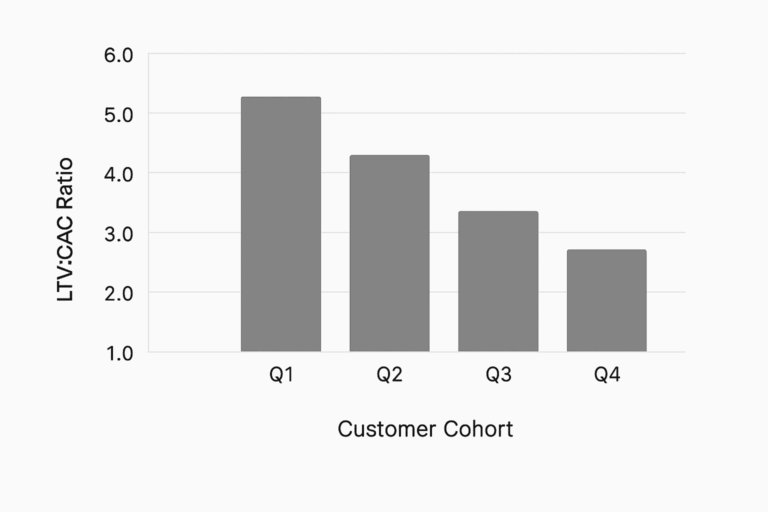
This chart shows how LTV: CAC ratios vary across customer cohorts. Each bar represents a group of customers acquired in a specific quarter. By comparing these ratios, you can spot which acquisition periods or strategies produced the highest value customers, and where performance dipped.
(In practice, cohort analyses are far more detailed; this chart simply illustrates how LTV: CAC ratios can vary over time.)
How to Increase Customer Lifetime Value
Sustainable LTV growth starts with continuous improvement, understanding customer behaviour, reducing friction, and crafting experiences that feel effortless.
Here are just a few ways you can improve CLV:
1. Prioritise Customer Satisfaction
Even if your product outperforms competitors, poor support will send customers straight to someone who treats them better. Ensure a frictionless experience throughout the entire customer lifecycle from sales, to customer onboarding, right through to customer retention. Schedule regular check-ins, maintain proactive communication, and use educational content to strengthen customer relationships and long-term loyalty.
2. Upsell and Cross-Sell Strategies
Use personalisation to craft highly targeted paid ads and email sequences around key usage milestones. Create retargeting audiences based on plan type or engagement level to promote relevant upgrades and higher-tier subscriptions.
Partnering with a SaaS-focused paid media agency can help you identify high-intent users, refine targeting, and scale upgrades that compound your customer lifetime value.
3. Build Customer Loyalty Through Personalisation
Leverage customer data such as feature usage and engagement history to tailor messaging and recommend relevant features. The goal is to make your ads and in-product experiences feel personal, keeping customers connected to your brand for longer. Incentivise loyalty by offering loyalty programs and perks to your most valuable customers.
We recommend always choosing SaaS-focused marketing agencies, whether it’s for email marketing, web design, or paid advertising, to ensure every touchpoint in your customer journey is optimised for long-term value.
4. Refine Pricing Strategies to Maximise Total Revenue
Offering multiple price plans not only attracts a broader audience but also helps convert less valuable customers into long-term subscribers as their needs evolve. Adjusting pricing tiers and upgrade paths based on usage patterns can increase monetary value per customer, boosting total revenue without necessarily raising acquisition costs.
As Alex Hormozi explains in his book, $100M Offers, the key to profitable growth lies in understanding what your customers truly value and structuring offers that feel irresistible. When your pricing strategy reflects perceived value, every customer relationship becomes more profitable.

The Bottom Line
At the end of the day, CLV is the metric that defines sustainable growth. It’s not just about what a customer is worth today, but the total value they bring over time. When paired with CAC, it shows whether you should scale up on growth or rein in your spend.
Focus on improving LTV through strong onboarding, proactive support, and smart personalisation, to make every dollar you spend on acquisition go further.
If you’re not sure where your ad spend is paying off (and where it’s burning budget), try our free CAC calculator or book a quick audit; we’ll help you uncover the numbers that fuel smarter, more profitable scaling.
CLV Calculators
Formula: LTV = (ARPU × Gross Margin) ÷ Churn Rate
£ Example: 80 = 80/month per active customer % Exclude marketing/acquisition costs (hosting, support, etc.) % Monthly % who cancel (e.g., 5 = 5%) Estimated LTV (gross profit) £1,280.00 Avg Customer Lifespan (months) 20.0 (£80.00 × 0.80) ÷ 0.05 = £1,280.00 Note: convert % to decimals in the math (80% → 0.8, 5% → 0.05). Tip: Use monthly ARPU and monthly churn. Lifespan ≈ 1 ÷ churn (when churn is monthly).Formula: LTV = Avg Order Value × Purchase Frequency × Customer Lifespan
£ Estimated LTV (revenue) £600.00 (£50.00 × 4 × 3) = £600.00 Profit-level (optional) Multiply by gross margin Note: This is revenue-level CLV. For gross-profit CLV, multiply by your gross margin (as a decimal).Tagged
- metrics