Research
Stop Chasing Cheap Clicks 2026: CPA by CPC in B2B Search
Snowball Creations' study of eight B2B Google Ads accounts: cost per acquisition by CPC bucket, brand and non-brand, every figure linked to its method.
Key figures
- Non-brand CPA on low-CPC search terms, eight B2B Google Ads accounts (Snowball Creations client data)
- $181.91 USD
- Non-brand CPA on high-CPC search terms, same eight accounts
- $99.90 USD (45.1% lower)
- Brand CPA on low-CPC search terms, same eight accounts
- $25.76 USD
- Brand CPA on high-CPC search terms, same eight accounts
- $147.09 USD (471% higher)
- Google Ads search spend analysed, eight B2B accounts, 24 months of data
- about $2.67M USD
Do cheaper clicks produce cheaper customers in B2B Google Search? This is the reference version of our own study, with the figures, the method and the limits in one place so they can be quoted accurately. Every number below is Snowball Creations client data, eight accounts, 24 months, read on 26 October 2026 off the published study. The 2026 in the title is this page’s edition: the data is the 24 months the study published in December 2025, not a 2026 measurement. The public, cross-platform benchmarks live on the hub, Paid Advertising Statistics 2026.
The dataset: eight B2B accounts, about $2.67M of search spend
The study covers about $2.67M USD of Google Ads search spend across eight B2B brands, using 24 months of each account’s data, as published by Max Sinclair on 5 December 2025 in CPA vs CPC: Are Cheap Clicks Really Better? and read again on 26 October 2026. Some of that history comes from before Snowball took the accounts over, so it reflects how the accounts were actually run rather than a controlled experiment. Every search term row from every account was pooled, and all currencies were normalised into US dollars.
That makes it operational data rather than an academic sample, and the study says so itself. Eight accounts is enough to show a pattern that repeats across them. It is not enough to rank industries, or to claim a figure for B2B advertisers in general, so if you quote it, quote it as “Snowball Creations client data, 8 accounts, 24 months, published 5 December 2025”.
Non-brand search: the cheapest clicks cost the most per conversion
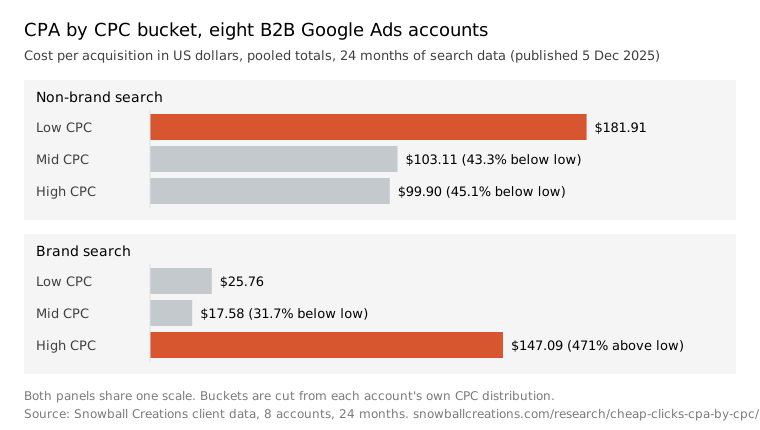
On non-brand search, cost per acquisition was $181.91 USD in the low-CPC bucket, $103.11 USD in the mid bucket and $99.90 USD in the high bucket, pooled across all eight accounts, per the published study, read 26 October 2026. The study gives the mid bucket as 43.3% below low and the high bucket as 45.1% below low. Both percentages are the study’s own, not arithmetic added for this page.
Put plainly, the search terms you paid least to have clicked were the ones that cost most to turn into a conversion. The study’s explanation is intent. Cheap clicks tend to come from broad, vague or informational queries, the person reading about a problem rather than shopping for a fix, while a higher click price usually means several advertisers want that searcher because they are closer to a decision.
One caution before you quote it. This is a pattern across search terms that already carried different prices, not a test of what happens when you raise a bid. Paying more for a low-intent query does not turn it into a high-intent one; it just makes the same visitor dearer.
Brand search: cheap wins, until the price spikes
Brand search ran the other way for most of the range. Cost per acquisition was $25.76 USD in the low-CPC bucket, $17.58 USD in the mid bucket (31.7% below low) and $147.09 USD in the high bucket, which the study gives as 471% above low, all read 26 October 2026. Cheap and mid-priced brand clicks were the most efficient traffic in the study, which is what you would expect: someone typing your name already knows who you are.
The high-CPC brand bucket is the exception, and the study names what was mostly in it: competitor bidding, ambiguous brand-like terms and mismatched close variants. So a good share of the “brand” traffic that cost the most was not really people looking for the brand. It was other advertisers pushing up the price of your name, or Google’s close-variant matching letting in queries that only looked like it.
What the data does not tell you
It does not say expensive clicks are good. It says that across these eight accounts click price was a poor guide to what a conversion cost, and that the direction flipped between brand and non-brand search. The published figures are pooled totals, and a pooled pattern can hide one account that behaves differently, so a cheap non-brand term that converts well in your account is still a cheap non-brand term that converts well.
Nor does it say anything about e-commerce. All eight accounts in the study are B2B, every row is a Google Search term, and Shopping, Performance Max and the other platforms are outside it. For the public averages on those, see Google Ads Statistics 2026 and PPC Statistics 2026.
Method
Inside each account, the study split every click into three CPC buckets, low, mid and high, cut from that account’s own CPC distribution rather than from one threshold across all eight. That matters because a click price that is cheap in one industry is expensive in another, and the post makes the point with cybersecurity and SaaS. Brand and non-brand search were analysed separately, because they behave differently in Google’s auction.
CPA was calculated from pooled totals, total cost divided by total conversions, rather than by averaging each account’s CPA, which avoids the average-of-averages distortion. The published post does not list the conversion actions counted in each account, the exchange rates used to normalise currencies, or the exact start and end dates of the 24-month window, so none of those appear here. It also introduces a summary of the combined dataset that was not readable as text when we read it on 26 October 2026, so impression, click and conversion totals are left off this page until they can be quoted from text.
Nothing on this page is derived. Every figure and percentage is quoted as the study published it, with nothing converted, rounded or recalculated. It is also not independent: Snowball Creations sells Google Ads management, these are our own clients’ accounts and the study is ours, so treat it as an agency’s first-party finding with its method stated, not a neutral survey of advertisers.
This page is maintained, rolled each January and updated if the study is extended with more accounts or a fresh period. It sits under the hub, Paid Advertising Statistics 2026.
What this means if you are running ads
Stop scoring search terms on cost per click. Score them on cost per acquisition, prune the cheap non-brand queries that never convert, and watch any brand term whose price jumps, because that is usually a competitor or a close variant rather than a customer. If you run Google Ads for a SaaS or B2B company and want someone to check which of your clicks are cheap for a reason, we manage paid ads for SaaS and B2B companies, and you can get in touch for a free account audit.
FAQ
Questions people ask
Does this mean I should raise my bids?
No. The study compares cost per acquisition across search terms that already cost different amounts; it does not test what happens when you pay more for the same term. A higher bid on a low-intent query buys the same low-intent visitor at a higher price. The useful change is to judge each search term on what it costs per conversion and stop treating click price as the score.
Why are the figures in US dollars rather than pounds?
The accounts were in more than one currency, so the study normalised everything into US dollars before pooling it, and the published figures are in dollars. We have not converted them into pounds, because a conversion would add an exchange rate the original analysis never used.
Does the finding hold for Google Shopping or e-commerce accounts?
We cannot tell from this data. Every account in it is B2B and every row is a Google Search term, so it says nothing about Shopping, Performance Max or a retailer's search terms. Treat it as a B2B search finding and test your own account before assuming it carries over.
Sources
Cite this page
Free to quote with a link back. Figures were last checked on 26 October 2026.
Snowball Creations, "Stop Chasing Cheap Clicks 2026: CPA by CPC in B2B Search", 2026. https://snowballcreations.com/research/cheap-clicks-cpa-by-cpc/
A plain-text version for AI tools and reference managers: /research/cheap-clicks-cpa-by-cpc.md