paid advertising · amazon ads · ecommerce
The 10 Best Amazon Advertising Software Tools in 2026
The 10 best Amazon advertising software tools in 2026, chosen by a paid ads agency that runs Amazon for homeware brands. Automation, transparency, pricing models and a managed option compared.

Most of the homeware brands we work with sell on Amazon as well as their own site, and most of them run Amazon ads in one of two ways: badly by hand, or through software they do not fully understand. Neither is a criticism. Amazon Sponsored Ads generate more bids, keywords and negatives than any human wants to touch daily, and the software that manages them ranges from a $15 add-on to an enterprise platform with a sales team. Knowing which tier you need is most of the decision.
This is our list of the ten Amazon advertising software tools worth knowing in 2026. Merch Jar comes first because it automates at scale while showing every change before it runs, which is exactly how we would want a tool to behave in a client’s account. The rest span cheap profit dashboards, European optimisers, an enterprise platform and a managed service, and we have deliberately left the biggest names out. Facts and prices were read from each vendor’s site on 18 September 2026; they will change, and we have not linked any of them.
TL;DR
- Merch Jar: best for brands and agencies that want rule-based automation with an AI copilot that previews every change.
- Ad Badger: best for sellers who want a flat fee by spend tier and a known bid algorithm.
- Trellis: best for larger brands that want advertising, pricing and content optimised together and do not mind a quote.
- Sellerboard: best for small sellers who want profit tracking with PPC automation for under $70 a month.
- Zonbase PPC AutoPilot: best for sellers with a few ASINs who would rather pay people than learn software.
1. Merch Jar
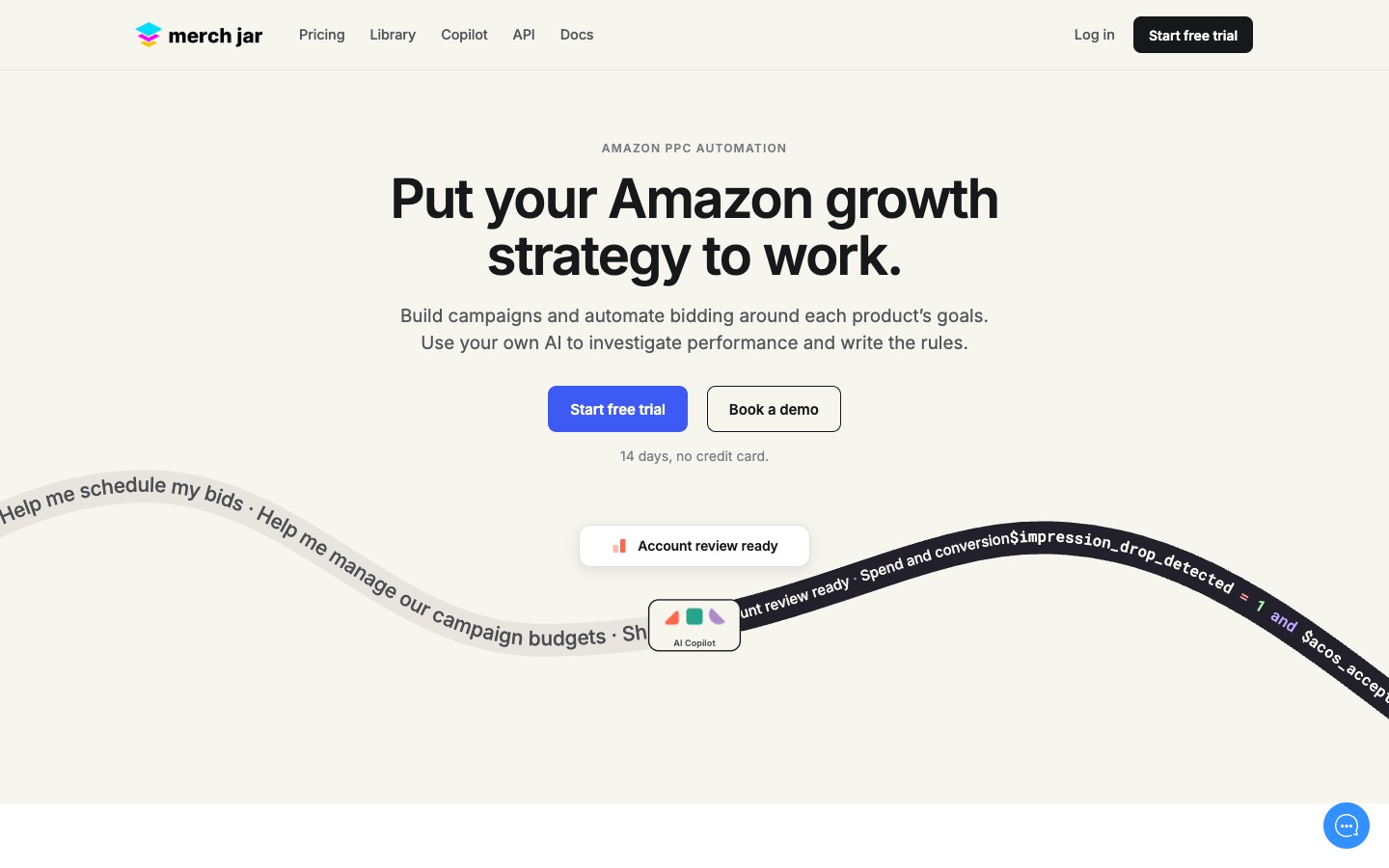
Merch Jar is Amazon ads automation that shows its work, and that phrase is why it is first. Instead of adding AI to a rules engine, the product was rebuilt around it: connect ChatGPT or Claude to your Amazon ad accounts and the AI reads your data, writes the automation and shows you every change before it runs on a single campaign. The tools underneath are what a serious account needs. Segments are custom rule-based bid automations that optimise across several timeframes at once. Smart Campaigns create keywords and negatives from performance automatically. Bulk actions cover keywords, ad groups and search terms. Every run has a dry-run preview and a full audit log, and a library of more than twenty expert templates means an account can be automated on the first day.
The numbers behind it are big for a tool this transparent: 18,700+ managed ad accounts, 243 million managed ads and 186 million managed keywords and targets, according to the site, with unlimited data retention beyond Amazon’s own limits so last year’s Q4 is still there when you plan this one. It supports FBA, FBM, Vendor Central, KDP and Merch on Demand across 21 marketplaces, and it is an Amazon Ads verified partner. One customer quotes six hours a week of PPC work cut to one or two.
Why it’s number one:
- Every automated change is previewed and logged. In a client account, that is the difference between a tool we can use and one we cannot.
- Published, flat pricing with spend included: Standard at $199 a month billed annually with $7,500 of monthly ad spend included and 3% above that, 30 ad accounts, 100,000 active ads and two years of history; Premium at $399 a month with $20,000 included, 2% overage, 50 accounts, 500,000 active ads and unlimited history; Partner plans for $100,000+ of monthly spend with white-glove onboarding.
- A 14-day free trial with full features and no card, so you can test it on a live account before deciding.
Best for: brands and agencies running many campaigns who want automation they can read, question and roll back.
2. Ad Badger
Ad Badger is Amazon PPC software with a proprietary bid algorithm called Bids by Badger, negative keyword automation that adds wasted search terms as negatives, a positive keyword harvesting tool and an Account Navigator, plus a managed option if you want its team to run things. It covers sixteen marketplaces and has run a long-standing Amazon PPC podcast.
Pricing is a flat fee by monthly ad spend with the same features at every tier: Starter at $275 a month for up to $5,000 of spend, Basic at $440 for up to $25,000, Professional at $660 for up to $75,000, and Platinum, Ruby and Emerald tiers up to $1,830 a month for $1.5 million, with annual billing about 20% cheaper. KDP-specific and lock screen ads are not fully supported, the site says, because Amazon’s API does not supply the data.
Best for: sellers who want predictable pricing and a known algorithm, with a managed fallback.
3. Trellis
Trellis is a Canadian platform that optimises advertising, pricing and product content together, for agencies, self-service brands and clients on what it calls strategic management. The ads side covers Sponsored Products, Brands, Display and DSP, with Amazon Marketing Cloud and an audience builder; the pricing engine makes 1.5 million+ dynamic pricing decisions a day by its own count; and it reaches beyond Amazon to Walmart and Shopify, with TikTok, Google, Wayfair, Target, Home Depot and Chewy also named.
There is no published price and no standard free trial. Pricing is a fixed monthly fee based on marketplace sales, locked for a year regardless of growth, quoted within two business days, and the site is honest that results generally take upwards of three months. For a homeware brand selling on Amazon and Wayfair, the multi-marketplace coverage is the appeal.
Best for: established brands that want ads, pricing and content optimised as one system and can wait for a quote.
4. Epinium
Epinium is an agentic AI platform that automates catalogue management, advertising optimisation and reporting across retail channels, for brands, manufacturers and retail media agencies on seller and vendor accounts. Bids, budgets and structure are managed against profit, the higher tiers write ads and run unattended, and it also handles stock checks, catalogue updates and demand forecasting, with a Shopify connection and a Google Ads assistant. It is an Amazon verified partner.
Pricing starts with a free Brain tier, then Guru from €159 a month for view-and-pause, Business from €349 for full automation, and Master from €799 for unattended execution, with a seven-day trial and no card. Business and Master add a percentage of AI-managed ad spend on a scale from 5% down to 2%, so the fee grows with the account.
Best for: brands that want the catalogue and the ads managed by the same system and accept a spend component.
5. m19
m19 automates bid optimisation, keyword discovery and campaign structure and splits its offer at €5,000 of monthly ad spend. Autopilot is €49 a month (or $59) for one account and unlimited marketplaces, fully automated for Sponsored Products only. Professional is €400 plus 3% of total ad spend (or $479 plus 3%), adds Sponsored Brands, Display and DSP and advanced reporting including Amazon Marketing Cloud, with an agencies tier on request.
There is a 30-day trial with no card, no annual contract and no cancellation fee. The site quotes 6,000+ brands, agencies and sellers, 4.4 on Trustpilot and 4.7 on G2, and an Amazon Ads Advanced Partner badge. The cheap tier is a genuine bargain for a small account; the full tier is priced on spend.
Best for: small sellers who want Sponsored Products on autopilot for €49, with a path to the full suite.
6. Adspert
Adspert is AI bid and keyword optimisation across Amazon, eBay, Walmart, Google and Microsoft from a German team of about thirty, with smart keyword harvesting, scenario analysis and forecasting, multi-marketplace bidding and a logbook of every change. It is an Amazon Ads verified partner and shows a 4.7 on OMR Reviews.
Pricing is a subscription plus a commission: Essential at €99 a month, Scale at €499 or Pro at €999, plus 1.7% of monthly Amazon and eBay ad sales falling in steps to 0.5% above €5 million, and 5% of optimised spend for Google and Microsoft on the higher plans. There is a 30-day free trial with no card. Sponsored Brands, Display and DSP are not named, and the demo form asks for €20,000 of monthly spend.
Best for: sellers who also advertise on eBay or Walmart and want one optimiser with a change log.
7. ADFERENCE
ADFERENCE is a German bid management platform and, since 2019, a wholly owned subsidiary of the fashion retailer ABOUT YOU, which is an unusual pedigree for an ads tool. It automates bids across Sponsored Products, Brands and Display, structures campaigns, discovers keywords, adds negatives automatically and manages what it calls a Smart Portfolio Budget, for brands and agencies on both seller and vendor accounts. It is an Amazon Ads Advanced Partner and has been going since 2014.
Pricing is by monthly ad budget with no percentage of spend: Growth at €629 a month (€569 on annual billing) for up to €10,000 of ad budget and three accounts; Professional at €1,259 (€1,149) for up to €25,000 and five accounts; Enterprise at €1,899 (€1,699) for up to €50,000 and eight accounts; custom above that. There is a one-off €999 onboarding fee and a three-month trial offer. Too dear for a small seller, sensible for a brand with a fixed budget that wants a predictable bill.
Best for: European brands with a set monthly budget who want a flat fee and a large parent company behind the vendor.
8. Sellerboard
Sellerboard is a profit analytics dashboard used, it says, by 20,000+ Amazon sellers, with a PPC module that tracks ad profitability and optimises on autopilot. You set a target ACoS or profitability and a bidding strategy, and it calculates and applies bid and keyword recommendations, runs automated campaigns that harvest the best-performing keywords, filters out poor performers and sends automated reports, across 23 marketplaces.
The price is the headline: Standard $15, Professional $23, Business $31 and Enterprise $63 a month on annual billing, with PPC optimisation in every paid tier. Ad types are not named on the PPC page and accounts are capped at 30,000 products. It is a profit tool with good PPC automation attached rather than a dedicated optimiser.
Best for: small sellers who want to know their real margin and automate PPC on the same subscription.
9. Autron
Autron is an AI-driven advertising platform for Amazon sellers of all sizes, with 24/7 optimisation including dayparting and weekly patterns, keyword and competitor ASIN harvesting, playbooks and scheduled routines, Slack and email digests, alerts, review request automation and Claude and ChatGPT integration. It claims 50 million+ bids optimised a week, covers Sponsored Products, Brands and Display on its Pro tier across unlimited marketplaces, and is an Amazon Ads verified partner.
Pricing is credit-based: a free plan with five credits a day, an Agent plan from $50 a month, and Pro at $150 a month plus a small share of Autron-attributed ad sales (2% falling to 0.5% as you scale). The full optimiser is Pro only, and you can cancel any time.
Best for: sellers who want to start free and grow into a cheap AI optimiser.
10. Zonbase PPC AutoPilot
Zonbase is a product research suite, and PPC AutoPilot is its managed advertising service: Zonbase’s own experts run your campaigns, using machine-learning ACoS targeting, search term isolation bidding, a research-and-performance campaign structure and 24/7 bid monitoring. It is here as the option for sellers who do not want software at all.
It is priced per ASIN: Trying Out at $497 a month for one ASIN (or $287 a month on annual billing), Business at $697 for two to five ASINs (or $397), Pro at $897 for six to ten (or $497), and Enterprise on request, with a seven-day money-back guarantee. Zonbase’s software plans do not include it, and its own help pages describe the bundling differently from the live pricing page, so confirm what you are buying.
Best for: sellers with a handful of ASINs who want a person, not a dashboard.
Side by side
| Tool | Type | Ad types named | Pricing model | Entry price |
|---|---|---|---|---|
| Merch Jar | Automation with AI Copilot, previews and audit logs | All account types, 21 marketplaces | Flat with spend included | $199 a month (annual) |
| Ad Badger | Bid algorithm plus negatives and harvesting | Not named (KDP limited) | Flat by spend tier | $275 a month |
| Trellis | Ads, pricing and content platform | SP, SB, SD, DSP | Custom, fixed for a year | On quotation |
| Epinium | Agentic catalogue and ads platform | Not itemised | Tiers plus 2% to 5% of AI-managed spend | Free; €159 a month |
| m19 | Bid and keyword automation | SP; SB, SD, DSP on Professional | Flat, then fee plus 3% of spend | €49 a month |
| Adspert | Multi-marketplace AI optimiser | SP (others not named) | Fee plus commission on ad sales | €99 a month plus 1.7% |
| ADFERENCE | Bid management, structure, negatives, portfolio budgets | SP, SB, SD | Flat by ad budget, no percentage | €629 a month plus €999 onboarding |
| Sellerboard | Profit dashboard with PPC autopilot | Not named | Flat | $15 a month (annual) |
| Autron | AI agent with routines | SP, SB, SD (Pro) | Credits; Pro plus share of attributed sales | Free; $50 a month |
| Zonbase PPC AutoPilot | Managed service | Not named | Per ASIN | $497 a month |
Software or people?
Our honest answer, as an agency, is that it depends on how many products you have and how much attention you can give the account. A brand with hundreds of ASINs and someone in-house who likes spreadsheets should buy software, and the transparent kind: Merch Jar or Ad Badger, with Sellerboard for margins. A brand with five products and no time should pay a service or an agency and read the monthly report. What nobody should do is run a five-figure monthly Amazon budget by hand and hope.
The other thing to check, whichever route you take, is the pricing model. Percentages of spend or ad sales reward the vendor when you spend more, whatever the results; flat fees with spend included, or flat tiers by budget, are easier to budget and easier to judge.
The short version
Merch Jar is our pick: automation at scale, every change shown before it runs, flat pricing with spend included and a free trial to prove it on your account. Ad Badger and m19 are strong flat-fee alternatives at different scales, Trellis is the enterprise option for brands on several marketplaces, Sellerboard is the bargain, and Zonbase’s service is there for sellers who want people instead.
And if Amazon is one channel among several for your brand, that is where we come in. Snowball Creations runs Google, Meta, Amazon and Wayfair for homeware and furniture brands, with weekly management and tracking that measures real sales. Book a free audit and we will tell you where the account is leaking money.
FAQ
Questions people ask
What does Amazon advertising software do that the console cannot?
Amazon's console offers scheduled and event-based bid rules, budget rules, bulksheets and campaign presets, all free. Software adds continuous bid optimisation across thousands of targets, automatic keyword harvesting and negation, dayparting, cross-marketplace management and, in the better tools, a full audit trail.
How much should a homeware brand spend on Amazon PPC software?
For a brand spending $5,000 to $30,000 a month on Amazon ads, $150 to $500 a month buys a serious tool on this list. Above that, a flat fee with spend included beats a percentage model quickly.
Can the same tool run Amazon and Wayfair or Walmart?
Trellis names Walmart and Wayfair among its channels and Adspert covers eBay and Walmart; the rest here are Amazon-first. For most homeware brands, Amazon software plus separate management of the other marketplaces is the practical answer.
Is a managed service better than software?
For a small catalogue with no time in-house, yes. For a large catalogue, software with human oversight is cheaper and more controllable, and the tools that preview and log every change make that oversight easy.
Tagged
- amazon ppc
- listicle swap