PPC Agency vs Freelancer vs In-House
PPC Agency vs Freelancer vs In-House. Which one wins? Each has real trade-offs. This guide helps you choose the right option for your business.
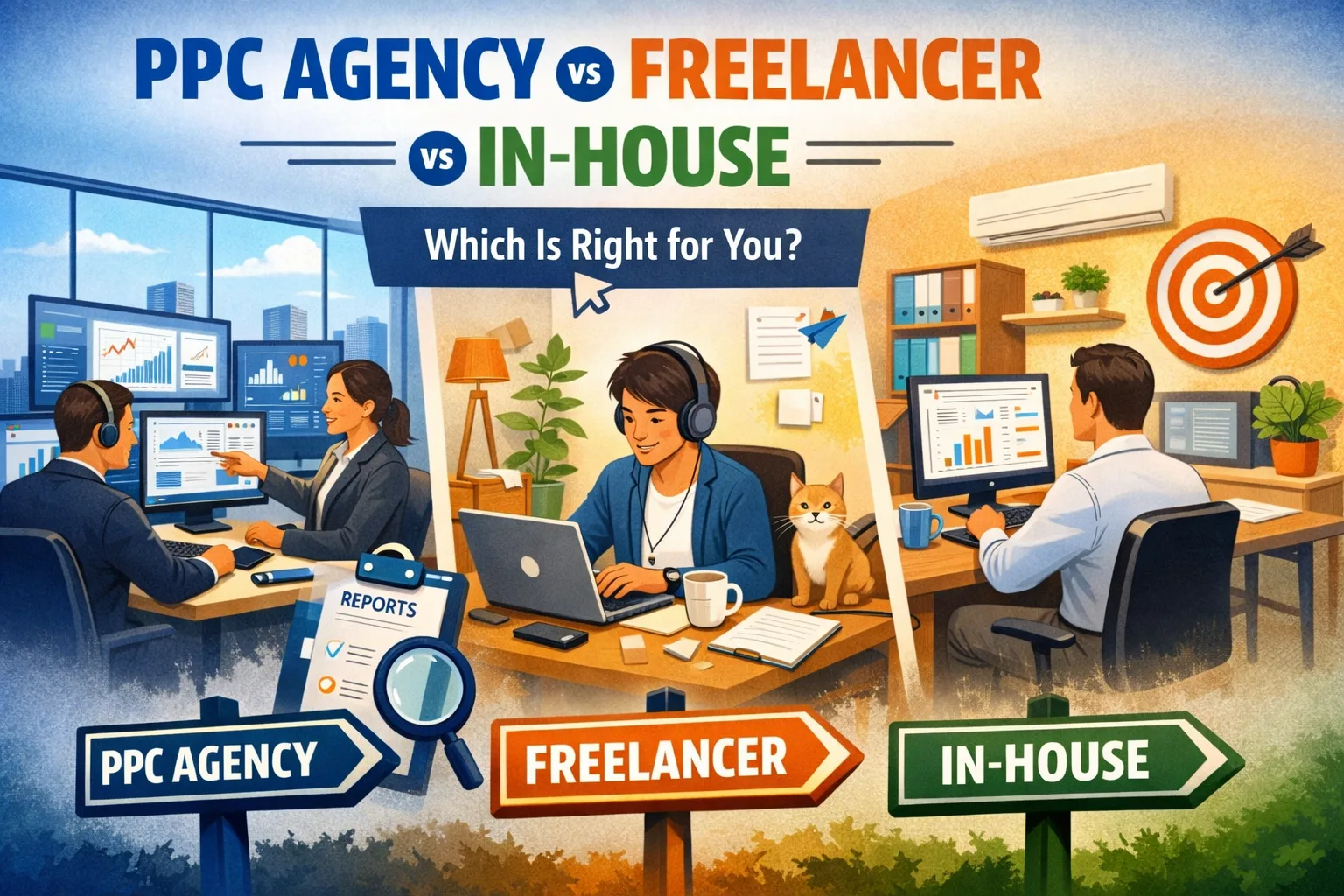
Most businesses get this decision wrong. They pick based on cost alone, end up disappointed, and then wonder why their ads aren't performing. The truth is, choosing between a PPC agency, a freelancer, and an in-house hire isn't just a budget question. It's a question of what your business actually needs right now — and those are very different things.
In this article, we're going to break down all three options honestly. What you get with each, where they fall short, and how to figure out which one actually makes sense for where you are right now.
Three Options, One Big Decision
At a surface level, the three options seem straightforward. An in-house PPC manager is someone you employ directly as part of your team. A freelancer is an independent specialist you bring in on a contract basis. And a paid ads agency is a dedicated team that manages your campaigns for a monthly fee.
But the differences go deeper than just the working arrangement. Each option comes with a different set of trade-offs around knowledge, availability, accountability, and cost. Getting this right can be the difference between ads that grow your business and ads that quietly drain your budget.
What You Get With an In-House PPC Manager
Having someone on the payroll who owns your paid media full-time sounds ideal in theory. They're close to the brand, they understand the business inside out, and you don't have to brief an external team every time you want to make a change. For larger companies with complex, always-on campaigns across multiple channels, this can genuinely work well.
The downsides, though, are real and worth thinking through carefully. A single in-house hire brings one person's knowledge to the table. They might be fantastic at Google Ads but weaker on Meta, or great at search but unfamiliar with more complex funnel strategies. If they leave, your campaigns stall while you recruit. And the total cost — salary, national insurance, holiday pay, tools, training — is often higher than people expect when they sit down and work it out.
In-house can also be slow to adapt. Paid media moves fast. Platforms update constantly, strategies evolve, and keeping up requires active learning outside of day-to-day campaign management. One person juggling live campaigns doesn't always have the bandwidth for that.
What You Get With a PPC Freelancer
Freelancers often get overlooked, which is a shame because for the right business at the right stage, they're genuinely a strong option. A good freelancer is usually a specialist who's gone independent because they're confident in their skills. You get focused expertise, typically at a lower cost than an agency, with decent flexibility in terms of how you structure the engagement.
They tend to work well for smaller budgets and simpler campaign structures, or businesses that just need one platform managed well. If you're spending a few thousand a month on Google Ads and don't need much else, a solid freelancer can do a great job without the overhead of a full agency relationship.
Where freelancers struggle is scale and reliability. They're one person. If they're ill, take a holiday, or just get busy with another client, your campaigns can suffer. There's no team behind them to pick up the slack, no one to pressure-test their thinking, and no redundancy if things go wrong. Their bandwidth is naturally limited, and if your needs grow quickly, you might outgrow them faster than you'd expect.
What You Get With a PPC Agency
A paid ads agency brings a team to your account. That might sound like a sales pitch, but practically speaking it means you're getting multiple people's expertise, cross-platform knowledge, and a structure that's built to handle change. Someone goes on leave? The account keeps running. You want to expand from Google into Meta or LinkedIn Ads? The capability is already there.
There's also a level of accountability that's harder to get elsewhere. Agencies are set up to track performance, report on it, and be answerable for results. A good agency won't hide behind numbers that look impressive but don't connect to actual results. They'll tell you what's working, what isn't, and what they're doing about it. That kind of structured relationship tends to push performance in a way that's difficult to replicate with a solo hire.
The honest downsides are cost and familiarity. Agencies cost more than freelancers, and they'll never know your business as intimately as someone who's been sitting in your office for three years. The briefing process takes effort. You need to invest time upfront so they truly understand your audience, your offer, and your goals. The businesses that get the most from agencies are usually the ones that treat it as a proper working partnership rather than a set-and-forget arrangement.
How to Choose Based on Where You Are Right Now
There's no single right answer here. The best option depends on a few honest questions about your current situation:
Budget: Freelancers are the most affordable option. Agencies cost more but typically manage larger budgets more efficiently. In-house is expensive when you add up the full employment cost.
Campaign complexity: Running ads across multiple platforms, targeting different audience segments, and managing creative testing? That usually calls for a team, not one person.
Internal bandwidth: Do you have someone internally who can be a strong point of contact, give strategic direction, and interpret reports? If not, an agency relationship becomes even more valuable, because they can fill that thinking gap.
Stage of growth: Early-stage businesses testing the water often start with a freelancer. Scaling businesses that need consistent, multi-channel execution are usually better served by an agency.
If your ad spend is modest, your campaigns are relatively simple, and you want a lean setup, a freelancer might be exactly what you need. If you're growing fast, running campaigns across multiple platforms, or trying to build something more sophisticated, an agency is usually the smarter call. And if you're a large business with complex needs and the budget to support a full-time specialist, an in-house hire starts to make sense.
It's also worth saying: these options don't have to be permanent. A lot of businesses start with a freelancer, grow into an agency relationship, and occasionally bring things in-house later. The important thing is choosing what fits your current reality, not what sounds most impressive on paper.
Finding the Right Fit for Your Business
The PPC agency vs freelancer vs in-house debate doesn't have a clean winner. What matters most is being honest about your budget, your ambitions, and how much support you actually need to get the most from your paid media. Cutting corners on this decision usually costs more in the long run than just getting it right from the start.
For most growing businesses, especially those running campaigns across more than one platform or looking to scale their ad spend meaningfully, working with a specialist agency tends to deliver the most consistent results. You get a team, you get accountability, and you get the kind of strategic thinking that's hard to replicate with a single hire.
If you're weighing up your options and want to talk it through with a team that's been running paid ads since 2017, we'd love to hear from you. Get in touch with Snowball Creations and let's work out what the right setup actually looks like for your business.