Software-as-a-Service (SaaS) has changed the way we buy, sell, and use software. Instead of one-time purchases, customers now subscribe to cloud-based tools that evolve with their needs. It’s a rapidly growing, fast-paced and sometimes complex industry that’s reshaping the future of business.
Whether you're a technical founder learning the commercial side or a marketer breaking into SaaS, this guide breaks down everything you need to know about selling and scaling software.
What Is SaaS Sales?
SaaS stands for Software-as-a-Service, a cloud-based business model where software is provided through a subscription rather than a one-time purchase.
There are two types of SaaS sales:
▸Business-to-Business (B2B): B2B software delivers cloud-based services and applications designed to help businesses and organisations manage their operations more efficiently. These tools often support areas such as project management, customer service, finance, and internal communication. Examples of well-known B2B software include platforms like Slack, Shopify and Zendesk.
▸Business-to-Consumer (B2C): B2C software provides cloud-based applications designed for individual users to access on their personal mobile or desktop devices. The B2C software market has grown rapidly thanks to its accessibility, affordability, and ease of use. Popular examples include streaming platforms like Netflix and Spotify, as well as cloud-based tools such as Google Docs and Dropbox.
Whether a company sells to other businesses or directly to consumers, SaaS sales models look different from traditional models. Let’s take a closer look at what makes them unique.
How SaaS Sales Differ from Traditional Sales
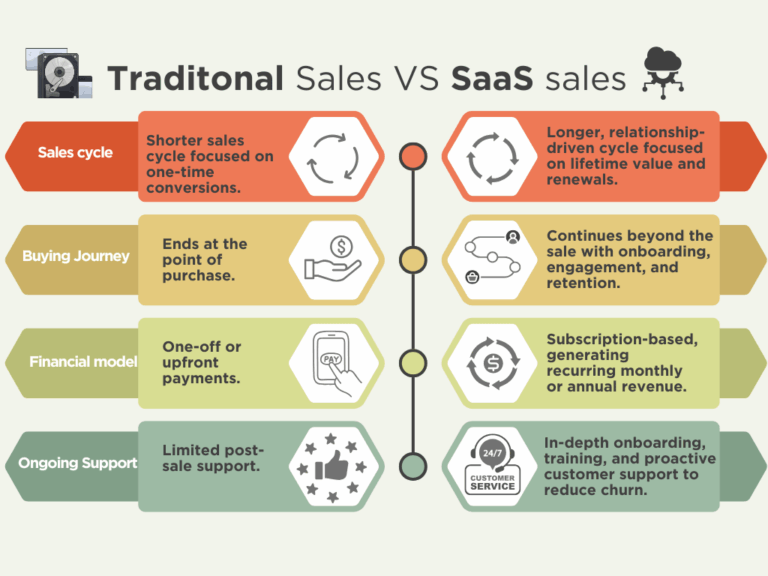
Although there has been a major shift toward the SaaS model, traditional (also known as on-premise) software still plays an important role in certain industries, particularly those that prioritise data control, security, and strict compliance regulations.
Think of traditional sales as asking for a date, and the SaaS sales process as asking for a marriage proposal. One takes a lot more nurturing and commitment to get a ‘yes.’
Traditional software sales typically involve a one-time purchase and require installation and maintenance on individual devices or internal company servers. This model often demands more upfront investment and technical setup compared to SaaS, but gives organisations complete control over their data and infrastructure.
Much like eCommerce, traditional software sales focus on creating value at the point of sale. Once the transaction is complete, the customer relationship generally ends there, a stark contrast to the ongoing engagement central to SaaS.
Because SaaS is subscription-based, there’s a strong emphasis on delivering value at every stage of the sales cycle, from onboarding and engagement to retention. The goal is to build long-term customer loyalty and maximise Customer Lifetime Value (CLV) to drive business growth.
SaaS sales cycles are also usually longer and involve more stakeholders, calling for a personalised, consultative approach as well as a solid grasp of technical details such as integrations and security.
The SaaS Sales Funnel
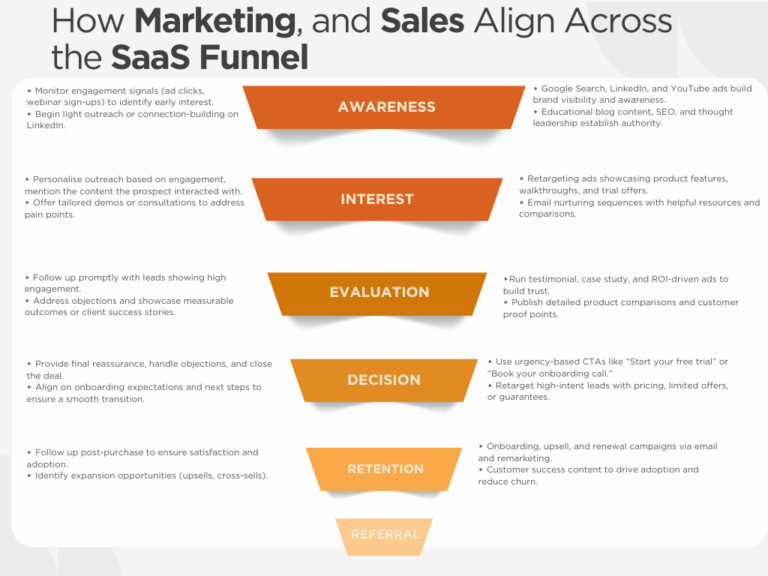
A sales funnel breaks down the customer journey into stages, from first touch to closed deal. It helps businesses understand where prospects are in their buying journey and what actions are needed to guide them toward conversion.
Unlike traditional funnels that end once a deal is closed, the SaaS funnel continues well beyond the sale, with sustained engagement required through multiple touchpoints.
Here are the 5 stages of the SaaS sales funnel:
1. Awareness
The funnel begins when potential customers first discover your product, often through marketing efforts such as SEO, organic content and paid advertising. SaaS sales reps may also use outreach tactics like cold email or LinkedIn to get on a prospect’s radar. The goal is simple: spark curiosity and start building trust.
2. Interest
At this stage, the lead is exploring your brand, visiting your site, reading reviews, or signing up for a free trial. The sales team’s job is to provide helpful resources, product insights, and case studies that move them closer to considering your solution.
3. Evaluation
Here, prospects are comparing you against competitors. They might request a demo or a detailed proposal. SaaS sales reps guide them by addressing pain points and tailoring tiers to fit their needs.
4. Decision (or Engagement)
Prospects are close to buying but need reassurance. Timely follow-ups, clear pricing, and transparent communication help them commit. Personalisation and trust are key at this point.
5. Purchase & Beyond
Unlike one-time product sales, the SaaS journey doesn’t end here. Post-purchase efforts such as onboarding and ongoing customer support, ensure long-term satisfaction. A great customer service experience can turn a new customer into a loyal advocate.
4 Common Challenges in SaaS Sales
Because SaaS products solve complex problems, the sales process comes with its own set of hurdles.
Let’s look at some of the most common challenges SaaS businesses face when turning leads into loyal customers:
1. Long Sales Cycles
SaaS prospects typically take longer to convert. Self-serve SaaS products, with simple pricing and intuitive interfaces, are designed for faster, low-touch conversions. However, B2B and enterprise SaaS involve far more complex sales and marketing processes.
These solutions often come with higher price tags and customised integrations, which means multiple decision-makers must evaluate the product. This process extends the sales cycle and increases the need for personalised engagement.
Benchmark: According to Hubspot, for small to medium-sized businesses, the sales cycle is on average around 60 days, and around 6 months long for enterprise sales.
Solution
▸Understand the evolving needs of buyers as they move through the funnel, and be proactive in addressing those needs at every touchpoint. Tailor your communication, content, and demos to each stage of the decision process to maintain momentum.
▸Prioritise high-intent leads using lead scoring to identify prospects most likely to convert. This helps your team focus resources where they’ll have the biggest impact instead of spending resources on low-intent leads that aren’t ready to buy
▸Drive action through personalisation. Buyers are bombarded by generic marketing messages, so make your touchpoints feel human and relevant. Personalise every stage of the journey, from emails sent by real people to tailored demos and paid media that align with a prospect’s recent activity, interests, or visited pages. Every interaction should demonstrate that you understand their challenges and show exactly how your solution can solve them. For best results, partner with a reputable SaaS marketing agency that can bring a personal touch to every campaign, from email marketing to branding and beyond.
2. Difficulty Generating Qualified Leads
You might have a great product, but struggle to attract the right customers. In a crowded SaaS market, lead generation is not about volume, but rather finding prospects who genuinely need your solution and are ready to convert. It can be difficult to identify and reach the right decision-makers within an organisation, especially when the buying committee includes multiple stakeholders with different priorities within the organisation.
Benchmark: According to Alexander Jarvis, a good lead-to-SQL conversion rate to aim for is between 35% and 45%.
Solution
▸Define your Ideal Customer Profile (ICP) by identifying the industries, company sizes, and roles most likely to benefit from your solution.
▸Tighten the net with audience segmentation, exact match keywords and filtering out poor-fit leads with negative keywords.
▸Use LinkedIn, Google, or Meta ads to reach specific decision-makers within your niche. Partnering with a SaaS-focused paid media agency can ensure the right channel mix, as well as precision targeting, for consistent lead quality.
3. Converting Trials into Paying Customers
Getting users to sign up for a free trial is one thing; turning them into paying customers is another. Here’s what most SaaS teams forget about free trials: users aren’t testing your product; they’re testing how effectively your software solves their problem.
They don’t care that your CRM integrates with 50 apps; they care that it saves them hours of manual data entry every week. Without clear guidance or motivation, trial users often fail to see how the software solves their specific problem, leading to low conversion rates and wasted acquisition spend.
According to Fincome, SaaS businesses typically convert around 15–25% of opt-in free trials, while products with strong onboarding experiences and clearly defined value propositions can achieve conversion rates of 30% or higher.
Solution
▸Choose the right trial model for your product. Not all free trials are created equal. Options like freemium, reverse trials, or time-limited trials with payment each serve different goals depending on your audience and product type. The key is to understand your customers’ expectations and choose the model that delivers value the fastest while motivating upgrades to paid plans.
For example, freemium models offer unlimited free usage, with an optional payment to unlock premium features. In contrast, a free trial provides full access to all features for a limited time, allowing users to experience the product’s complete value before committing.
▸Segment your users and analyse their behaviour.
Not all trial or freemium users behave the same way. Identify who’s actively exploring versus passively browsing, and tailor your onboarding, messaging, and upgrade prompts accordingly. Personalised communication drives higher engagement and conversion rates.
For instance, some users barely log in or explore any features. These users often need extra nurturing or follow-up to help them understand the product’s value and how to use it effectively.
▸Track and optimise with analytics. You can’t improve what you don’t measure. Track and analyse key metrics to uncover bottlenecks and opportunities for growth. The most important metrics to consider are: trial-to-paid conversion rate, activation rate, churn rate, and CLV growth (more on these metrics later).
4. Customer Churn
Churn is something every SaaS founder faces; it can’t be eliminated, but can be reduced. Customer churn refers to the percentage of customers who stop using your product over a specific period of time.
Churn doesn’t reflect a customer service problem, but rather a growth problem. Every lost customer represents lost recurring revenue and the investment put into acquiring that customer in the first place.
According to Churnfree, an annual churn rate of 5% or lower is considered healthy for maintaining sustainable growth in B2B SaaS, helping companies offset customer losses year over year.
Solution
▸Increase personalisation
When done right, personalisation strengthens engagement and reduces churn. This includes delivering messaging and content that feel genuinely relevant to the customer’s goals and context.
For instance, your business might offer live onboarding calls for high-value customers, allowing them to ask questions in real time and connect directly with your team, adding a human touch through names and faces. While this isn’t always feasible in low-touch models, you can still deliver relevance at scale through targeted content and in-app experiences that address each user’s specific needs.
▸Implement customer feedback
Turning customer feedback into action is one of the most effective ways to reduce churn. It allows your team to identify issues before they escalate, allowing you to become proactive rather than reactive. Collect feedback at multiple stages of the customer journey, through surveys, in-app forms, social listening, and check-in calls. Closing the loop by acting on this input shows customers their opinions matter and drives long-term loyalty.
▸Monitor churn precursors
Use product analytics and customer success tools to identify early warning signs, such as inactivity or reduced usage. Create automations that trigger personalised check-ins, reminders, or helpful resources before issues arise. Proactive engagement shows attentiveness and keeps customers connected to your product’s value.
How Marketing Fuels SaaS Sales Growth
Marketing is the key to helping SaaS customers understand how your product addresses their most significant pain points. Because SaaS products are intangible, they’re inherently harder to market. Add in long sales cycles, and you have buyers who need regular reminders of why your service is worth investing in.
When developing your SaaS marketing strategy, the key is to strike a balance between fast-acting outbound campaigns and long-term inbound strategies that build trust over time.
Inbound Marketing
Inbound marketing focuses on attracting potential customers by providing value-driven, relevant content that solves their problems. It uses a ‘pull’ approach to draw people in through SEO, blog posts, social media, and email nurturing, helping build trust and position your brand as an authority long before a sales conversation begins.
Benefits of inbound marketing for SaaS
▸Builds long-term trust. Sharing valuable, educational content helps you become a trusted voice in your industry, opening the door to referrals and greater brand visibility.
▸Generates consistent organic traffic and qualified leads. Strong SEO takes time to build, but once it gains momentum, it continuously attracts high-intent prospects actively searching for solutions like yours.
▸Can reduce Customer Acquisition Cost (CAC) over time. Once you’ve built a library of evergreen assets, they continue attracting qualified leads without ongoing spend, reducing your overall CAC. The same with SEO, once your content starts ranking, it can drive a steady flow of high-intent traffic with little additional investment
Outbound Marketing
Outbound marketing, on the other hand, takes a proactive ‘push’ approach. It focuses on reaching out directly to potential customers through paid advertising, cold email, or outbound sales outreach. Unlike inbound marketing, outbound can deliver immediate visibility, making it ideal for accelerating growth and for supplementing slower-building inbound strategies.
Benefits of outbound marketing for SaaS
▸Generates immediate visibility and leads. Outbound marketing like paid media campaigns or cold outreach, can quickly put your product in front of decision-makers. This can be ideal for early-stage SaaS companies that don’t have organic traction yet.
▸Targets specific audiences with precision. Paid media platforms like LinkedIn, Meta, and search engines allow you to target your ideal customers based on detailed criteria such as job title, location, interests, and keywords.
▸Targets every stage of the funnel. Outbound marketing gives SaaS teams the flexibility to engage prospects across all funnel stages. For example, top-of-funnel ads can build brand awareness, mid-funnel campaigns can promote free trials or webinars, and bottom-funnel outreach can target warm leads with demos or personalised offers.
▸Can also reduce Customer Acquisition Cost (CAC) over time. It might sound counterintuitive, but paid ads can reduce CAC (Customer Acquisition Cost) over time, but only when they’re highly targeted, well-optimised, and part of a data-driven funnel.
Aligning Sales with Marketing
Sales and marketing might play different roles, one builds personal connections, the other drives awareness at scale, but both are working toward the same goal: growth. However, achieving that goal is impossible without true alignment between sales and marketing.
When Sales and Marketing aren’t aligned, friction follows, budgets are wasted on unqualified leads, messaging loses consistency, and potential revenue slips through the cracks.
Common Breakdowns Between Sales and Marketing
▸ Different goals and a focus on different metrics. Different goals and misaligned metrics. A common source of friction between sales and marketing is their focus on different key performance indicators (KPIs). Marketing often prioritises traffic growth and engagement metrics such as click-through and lead volume, while sales teams are measured by acquisition and deal closures. This misalignment can lead to marketing delivering leads that sales deem unqualified, resulting in inefficiency and wasted resources.
▸Solution: Create shared goals and KPIS across teams such as increasing revenue growth, and reducing customer acquisition cost (CAC). For example, instead of measuring marketing on lead volume alone, incentivise them based on lead quality and sales impact. Likewise, assess sales not just on closed deals but on how effectively they follow up on marketing-generated leads.
▸ Lead qualification discrepancies. A lead is more than just a job title or a website signup; it’s about intent. Misalignment often happens when marketing defines a lead based on surface-level criteria (e.g., downloads or form fills), while sales evaluates based on buying potential. Without a shared definition of an Ideal Customer Profile (ICP) and what makes a qualified lead, teams waste time nurturing or chasing prospects who aren’t truly ready to convert.
▸Solution: Aligning on an Ideal Customer Profile (ICP) and shared qualification criteria, as well as implementing a lead scoring system, helps align expectations by ranking leads based on engagement, fit, and buying intent.
▸Misaligned messaging. When sales and marketing don’t collaborate, messaging often becomes fragmented. Prospects expect consistency across every touchpoint, from ads and content to demos and follow-up conversations. However, when marketing promotes features that sales don’t mention (or vice versa), it creates confusion and frustration. This disconnect erodes trust and can cause prospects to drop out of the funnel entirely.
▸Solution: Create a shared messaging framework that maps value propositions across funnel stages. Run regular syncs to ensure new campaigns and sales scripts stay consistent.
Paid Ads Strategies That Support SaaS Sales
Paid advertising is one of the most direct ways to bridge the gap between marketing and sales. Even when your ideal customer is not ready to buy yet, paid advertising allows you to build awareness, get on your potential customer’s radar so that you can continue to guide them further down the funnel until they are ready to convert.
There’s no denying the value of organic marketing, but paid advertising offers something organic channels can’t speed and scale. But there are a few things to keep in mind before investing in paid advertising.
Before You Invest in Paid Advertising
Paid advertising can accelerate growth, but it’s not a silver bullet. Before spending a cent, SaaS founders should carefully consider whether their product, audience, and budget are ready for scalable acquisition. Here’s how you can do that:
▸Assess product–market fit. Founders often assume they’ve reached product–market fit too early. A few enthusiastic adopters and initial sales can create a false sense of validation. Paid ads can amplify this illusion of demand, masking deeper product–market fit issues and leading to high churn or wasted spend.
▸Solution: Before scaling with paid advertising, focus on identifying the small group of users who truly rely on and are willing to pay for your product. Refine your offer through organic traction, user feedback, and retention before investing heavily in paid acquisition.
▸ Assess market size. Ad platforms rely on scale and data. If your total addressable market is very small (fewer than 1,000 potential customers), you’ll quickly exhaust your reach. More importantly, ad algorithms won’t have enough data to optimise performance, making cost-per-clicks higher and conversions inefficient.
▸Solution: If your market is small, paid ads may not be the most efficient channel yet. Focus instead on direct outreach and organic channels to engage your limited audience more personally. Consider diversifying your product or service offering to tap into adjacent customer segments or industries.
▸Calculate lifetime value (LTV). Paid ads can quickly become unsustainable when your competitors earn significantly more per customer with the same cost base. If you make £100 per sale and they make £200, they can comfortably spend twice as much to win that same customer, and outbid you every time. This becomes even more challenging in the SaaS space, where multiple companies compete for the same audience, driving up keyword auction prices and cost-per-clicks.
▸Solution: Increase your customer lifetime value before scaling paid ads. (Your LTV-to-CAC ratio determines how much you can afford to spend to acquire a customer while staying profitable.) You want to have an LTV-to-CAC ratio of at least 3:1. As an example, if your lifetime value is £600 and your CAC is £200, you’re earning £3 for every £1 spent, which is a healthy ratio to give you room to scale your ad spend sustainably. To increase LTV, explore upsells, feature-based pricing, or longer-term contracts to boost revenue per user. The higher your LTV, the more competitive you become in ad auctions without compromising profitability.

Selecting your Channel Mix
Each advertising platform brings its own strengths and plays a distinct role in the SaaS buyer journey. The right mix depends on your goals, audience, and where prospects are in the funnel.
Paid Social Advertising: Build Awareness and Nurture Demand
Best for:
▸Early-stage SaaS brands building awareness
▸Long sales cycles where education is key
▸Companies with strong creative assets and clear value props
Key Platforms:
▸LinkedIn Ads, unparalleled for B2B targeting (job title, company, seniority, industry)
▸Meta Ads, excellent for scale and retargeting, with powerful algorithms
▸YouTube Ads, X and Reddit, while not usually primary acquisition channels, can be effective supplements in niche cases.
Paid Social Strategy Tips
▸Match platform to audience. For most SaaS brands, LinkedIn and Meta deliver the strongest ROI. LinkedIn offers unmatched precision for B2B targeting by job title, company size, and industry, but it can be a learning curve with a higher cost per click (CPC). Meta’s scale and algorithmic intelligence make it ideal for broad awareness and remarketing. Use LinkedIn for relevance and Meta for reach.
▸Test creative formats relentlessly. Creative can be the make-or-break factor in paid social performance. Test multiple hooks, visuals, and formats to find what resonates. Authentic, founder-led videos or user-generated content can outperform polished brand ads.
▸Leverage retargeting. Your best leads often come from the second or third touchpoint. Retarget visitors who’ve viewed pricing pages, started trials, or engaged with key content. Pair educational or comparison-based creative with strong CTAs to move them closer to conversion.
▸Track the right metrics. Focus on downstream performance, not vanity metrics like impressions or CTR. Measure cost per qualified lead (CPL), demo booked rate, and trial-to-paid conversions. Keep in mind that Meta’s short attribution window (1-day view, 7-day click) can under-report conversions for long SaaS sales cycles, so sync CRM data or use third-party tracking tools to capture the full picture.
Paid Search Advertising: Capture Intent
Paid search is the foundation of most high-performing SaaS ad strategies, and for good reason. It’s intent-driven. Every click represents someone actively searching for the problem you solve, assuming you’ve already validated product-market fit.
Best for:
▸B2B SaaS companies with active search demand
▸Bottom-of-funnel leads ready to buy
▸Established product-market fit
Key Platforms
▸Google Ads, the go-to for capturing buying intent
▸Bing (Microsoft) Ads, often cheaper CPCs, older and more corporate audiences
Search Strategy Tips
▸Use exact and phrase match keywords. This narrows Google’s room for interpretation, ensuring your ads only appear for searches that closely match your offer. It’s one of the simplest ways to protect your budget from irrelevant or low-quality clicks.
▸ Add negative keywords. Exclude search terms that signal low intent interest. This prevents your ads from showing for lookalike queries with no commercial value. For example, if your accounting software runs on a paid subscription, filter out searches like ‘ open source accounting software.’
▸Avoid performance Max. Performance Max is Google's ‘do-it-for-you’ campaign type that automatically distributes your budget across Search, Display, YouTube, Maps, and Gmail. While it promises convenience, it often prioritises reach over precision, meaning you lose control over where your ads appear and who sees them.
▸Lead with clarity and relevance in your messaging. Highlight the problem your software solves and test pricing-related copy sparingly, as early-stage leads may not be ready to buy yet.
▸Optimise landing pages. Where your ads send traffic is just as important as the ads themselves. Direct users to dedicated, optimised landing pages that match the keyword’s intent. A well-aligned page improves Quality Score, reduces cost-per-click, and significantly increases conversions.
If you’re on the fence about hiring an agency, but still want expert-level results, try setting up and managing your own campaigns with The SaaS Ads Studio. Our step-by-step software that distils the exact systems our team uses to build and optimise profitable Google Ads campaigns.
Key Metrics to Track in SaaS Sales
The more clearly you measure performance, the easier it becomes to optimise spend, reduce CAC, and maximise ROI.
Here are the key metrics every SaaS team should measure:
▸Return on Ad Spend (ROAS) measures how much revenue is generated for every dollar spent on advertising. It helps determine the profitability and efficiency of your paid campaigns across platforms.
▸Conversion Rate tells you the percentage of users who complete a desired action, such as signing up for a trial, booking a demo, or subscribing. It reflects how effectively your website or campaigns turn visitors into engaged prospects.
▸Customer Acquisition Cost (CAC) equals the total cost of acquiring a new customer, including marketing and sales spend. CAC helps determine how efficiently you’re scaling and whether your acquisition strategy is sustainable.
▸Cost Per Acquisition (CPA) gives you a more granular version of CAC. Cost Per Acquisition measures the cost of acquiring a single customer or conversion within a specific campaign or channel. While often used in paid advertising, it can apply to any trackable acquisition effort.
▸Customer Lifetime Value (CLTV) is the total revenue a customer is expected to generate throughout their relationship with your business. A healthy CLV-to-CAC ratio (ideally 3:1 or higher) indicates scalable growth.
▸Churn Rate gives you the percentage of customers who cancel or fail to renew their subscriptions within a specific period. Reducing churn directly improves profitability and long-term customer retention.
▸Monthly Recurring Revenue (MRR) is your subscription-based income from active customers on a monthly basis. MRR helps forecast growth trends, measure expansion, and track retention success.
▸Annual Recurring Revenue (ARR) represents the predictable, subscription-based revenue your business can expect to generate over a year.
▸Free Trial Conversion Rate measures how effectively your free trial users convert to paying customers, a direct indicator of product value and onboarding experience.
▸Net Promoter Score (NPS) assesses how likely customers are to recommend your product to others. A strong NPS signals customer loyalty and brand advocacy potential.
▸Lead Scoring ranks leads based on their likelihood to convert, using engagement signals such as website visits, feature usage, trial activity, and content interactions. It helps sales prioritise high-intent prospects and shorten the sales cycle.
To Sum Up
The SaaS industry is evolving faster than ever, and so should your approach to growth. Whether you’re seed stage or scaling your operations, evolving your strategy means aligning your marketing and sales efforts as well as investing in sustainable acquisition channels that drive long-term revenue.
If you’re ready for a paid media strategy that complements your sales process and drives sustainable growth, partnering with a SaaS-focused agency can help you scale with precision. If that’s what you’re looking for,book a call to get the ball rolling.
Tagged
- b2b