paid advertising · ad agency · ppc · budgets
How Much Does a PPC Agency Cost in the UK?
What a UK paid ads agency charges each month, why fees are quoted per platform, and how to judge the number against your own margins.

The short version
- A UK paid ads agency is priced as a monthly management fee, and your ad spend is separate money that goes to Google, Meta or LinkedIn from your own account.
- Our fees start at £1,749 per platform per month, on a three-month commitment and then one month’s rolling notice.
- We ask for a minimum ad spend of £2,500 a month per platform, because a month below that does not produce enough data to make decisions with.
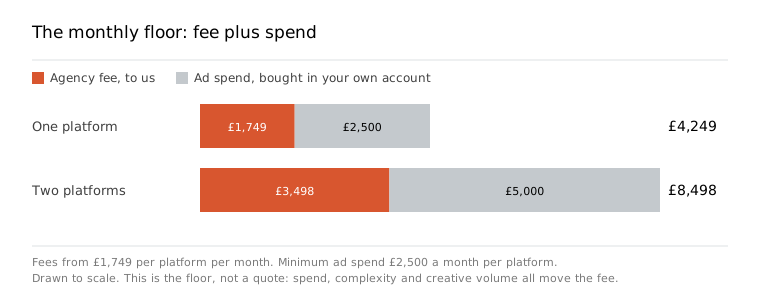
- At those two floors, one platform costs £4,249 a month in total, and two platforms £8,498.
- The fee is worth paying when the account can carry it inside your cost per acquisition. If it cannot, hiring anybody is the wrong spend this quarter.
Hiring a paid ads agency in the UK means paying two different things to two different places. The fee buys the management, and ours starts at £1,749 per platform per month on a three-month commitment, then one month’s rolling notice. The spend buys the clicks, and we ask for at least £2,500 a month per platform. So the smallest sensible total for a single platform is £4,249 a month, of which £1,749 comes to us and £2,500 goes to the platform. Whether that counts as expensive depends entirely on what a customer is worth to you.
What the fee covers, and what it does not
The fee covers the work: strategy, campaign build, ad creative, conversion tracking, and the weekly, monthly and quarterly lever checks on every platform we run. It does not cover the media. The ad spend is billed by the platform inside your own ad account, and none of it is ours.
That distinction matters more than it sounds, because the management is the part people underestimate. Setting an account up is a fraction of the job. The money is made in the weeks afterwards, in the checks: search terms, negatives, bids, budgets, creative rotation, and whatever the platform quietly changed while you were busy running your business. A campaign nobody checks is a campaign the platform runs for itself, and a rep’s advice is written for the platform’s revenue rather than for yours.
So when you put two quotes side by side, you are not really comparing prices. You are comparing how often somebody will open the account, and how senior that somebody is. Our own view of whether an agency is worth it at all starts in the same place.
Why the fee is quoted per platform rather than per account
Because each platform is a separate job with its own levers, its own creative and its own weekly checks. Google Search, Google Shopping, Meta and LinkedIn do not share a build, a strategy or a reporting rhythm, so an agency running three of them is doing three jobs, and a single flat fee for “paid ads” hides which of the three is actually being worked.
Priced per platform, the arithmetic stays honest and you can start narrow. One platform at the two floors is £1,749 of fee and £2,500 of spend, so £4,249 a month. Two platforms is £3,498 and £5,000, so £8,498. That is a floor rather than a quote: spend, complexity and creative volume all move the fee.
Most clients start on one platform and add a second once the first is earning. For software the mix usually ends up weighted to Google with LinkedIn alongside it, which is why our paid ads work for SaaS and B2B is quoted that way; for homeware and furniture brands it is Standard Shopping first, with Performance Max as an experiment beside it rather than instead of it. If you are still sizing the spend itself, we have written separately on how much budget each platform needs and on whether a minimum budget exists.

The four ways agencies price paid ads
There are four common models in the UK: a percentage of your ad spend, a flat monthly fee, a hybrid of the two, and performance pricing. Each one quietly points your account somewhere, so the model deserves as much attention as the number attached to it.
- A percentage of ad spend. Simple to understand, and it pays the agency more when your budget rises, whether or not the rise was a good idea. Ask who decides the budget.
- A flat monthly fee, per platform or per account. Predictable, and it pays for the work rather than the size of the cheque. This is what we do.
- A hybrid: a smaller base fee plus a percentage above some spend threshold.
- Performance pricing: a share of revenue, or a fee per lead. Appealing right up to the first argument about attribution.
Our own bias is worth stating plainly. We never more than double an account’s spend inside a single month, and we scale on impression share and volume rather than on one good week, so a fee that grew with spend would be paying us to break our own rule. A flat fee per platform also means nobody in the room has to wonder why the recommendation is always to spend more. The same logic sits behind our comparison of an agency, a freelancer and an in-house hire.
What the first three months actually buy
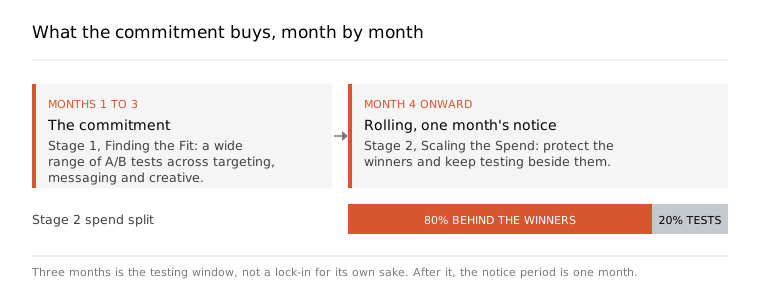
A three-month commitment, then one month’s rolling notice. The three months are not a lock-in for their own sake: they are the shortest honest window for Stage 1, Finding the Fit, where we run a wide range of A/B test variants across targeting, messaging and creative to find which roads lead to the highest uptick. Conversion tracking, including offline conversions back to your CRM, is set up before a pound is spent, because a test you cannot measure is just a donation.
Then comes Stage 2, Scaling the Spend: protect the winners, put about 80% of the spend behind them and about 20% into new tests. That is the point at which the fee starts to look cheap, and it is also why an agency judged on month one is being judged on the wrong month.

Judge the fee inside your cost per acquisition
The only useful test is arithmetic rather than sentiment: add the fee to the spend, divide by the customers it produced, and compare that against what a customer is worth to you over their life. A £1,749 fee on £2,500 of spend is a large percentage of the total; the same fee on £25,000 of spend barely registers. The account either pays for both halves or it does not.
Two numbers from our own list, with their qualifiers intact. Our clients average 5.1x ROAS, calculated over the previous four months of ad spend, including agency fees, which is the only version of that figure a buyer should accept. And on Google Shopping, Hairpin has seen 8x ROAS, £5m in sales from £627k of ad spend over five years.
Neither is a promise about your account. They are the shape of what a fee is meant to buy, and the reason we would rather be judged on cost per acquisition than on the size of a monthly invoice. Cheap clicks, as our own research into CPA and CPC found, are a very different thing from cheap customers.
When hiring anyone is the wrong spend
Some businesses should not hire an agency this quarter, and saying so on a first call saves everyone three months. We say no when the product has not found its fit yet, because ads are the most expensive way to discover that. We say no when nothing else in the business converts: if the site and the offer convert nobody today, more traffic changes the size of the problem and not the problem itself.
We also say no below £2,500 a month per platform, and when margins or lifetime value are too thin to pay for a click a competitor can happily pay twice for. None of that is a negotiating tactic. It is the same arithmetic as above, run before the invoice instead of after it, and it is why our view of paid media management starts with the account rather than the ads.
Working out your own number
Give your own numbers ten minutes. What is a customer worth over their life, how many do you need a month, and what can you afford to pay to acquire one? Multiply back from there and you will know whether £4,249 a month on a single platform is ambitious, comfortable or faintly silly for your business, which is a far better question than what agencies charge in general.
If you would like a second opinion on the account you already have, ask us for the free account audit: we will tell you what we would change, and whether it is worth paying anyone to change it.
FAQ
Questions people ask
Can I change the ad budget once campaigns are running?
Yes, any month, and the spend is your money in your own ad account. The one thing we will not do is more than double an account's spend inside a single month. We scale on impression share and volume rather than on a good week, because a sudden budget jump is one of the fastest ways to lose a campaign that was working.
What happens when the three-month commitment ends?
It becomes rolling on one month's notice, so from month four you are staying because it works rather than because you signed something. We would rather be judged that way: the weekly lever checks are the product, and they are easy to inspect month by month.
Should I start on one platform or two?
Usually one, then add a second when the first is earning. For B2B SaaS the mix tends to settle near 75 per cent Google and 25 per cent LinkedIn, and we never run LinkedIn on its own: it creates the demand that Google later converts, and its cost per lead sits above Google's.
Who owns the ad accounts and the tracking?
You do. We work inside your own accounts, so if we ever part company you keep the campaigns, the history and the conversion tracking. An agency that cannot hand those over has not really built you anything.