paid advertising · ad agency · google ads · ecommerce
Top Google Shopping Agencies in the UK (2026)
Five notable UK Google Shopping agencies for furniture and homeware brands, and what each one actually does with your Merchant Centre feed.

Google Shopping is where most furniture and homeware brands make their money on Google, and it is also the part of the account that gets the least attention. Search campaigns get rebuilt every year; the product feed sits there for two years with titles nobody has read since the site launched. This list is for founders and marketing heads at product businesses who want someone who will actually open Merchant Centre on a Tuesday morning.
Five UK agencies are below, and “top” here means notable and active rather than ranked by quality. We have deliberately left out the agencies already sitting on page one for the term this article targets, since you will find those on your own, and picked smaller, lesser-known and adjacent specialists instead. We are Snowball Creations, we run Shopping for furniture and homeware brands, and we are first because it is our list. Every fact about the other four was read off that agency’s own website on 23 September 2026.
The short version
- Snowball Creations: for 7-figure homeware, furniture, SaaS and B2B brands that want Standard Shopping run properly and Performance Max kept as an experiment.
- Onefeed: for brands whose real problem is the product feed rather than the campaigns.
- Evoluted: for brands whose Shopping problem starts in the website and the product data behind it.
- Visualsoft: for retailers who would rather take the platform and the advertising from one supplier.
- Internet Marketing Team: for smaller catalogues, and for agencies who want Shopping run white label.
Snowball Creations
We are a London-based paid ads agency, founded in 2017, running Google, Meta, LinkedIn, Microsoft, Amazon and TikTok for 7-figure SaaS, B2B and homeware e-commerce brands. On Shopping our position is plain: Standard Shopping is the go-to, and Performance Max is an experiment run beside it rather than the whole account.
That matters more than it sounds. Handing a catalogue to automation and hoping is the most common way we see a furniture brand lose a quarter, because afterwards nobody can say which products the money went to. We split the catalogue by price tier, check the levers weekly, monthly and quarterly, and refuse to be clever before the tracking works: conversion tracking, including offline conversions back to the CRM where there is one, goes in before a pound is spent.
Why They’re a Good Choice
- Hairpin, a UK furniture brand, runs Google Shopping with us at 8x ROAS: £5m in sales from £627k of ad spend over five years.
- Tom Raffield, in furniture and lighting, now has Google Ads as their primary acquisition channel, £3m in sales from £544k at 5.5x since 2020.
- Weekly, monthly and quarterly lever checks on every account, rather than a build and a monthly report.
- Two stages we say out loud: finding the fit, then scaling the spend with about 80% behind the winners and 20% into new tests.
- Fees from £1,749 per platform per month, a three-month commitment then one month’s rolling notice, and a minimum ad spend of £2,500 a month per platform.
Onefeed
Onefeed is a Google Shopping and feed management specialist that also builds its own software, which is a rarer combination than it sounds. Its Google Shopping management page, read on 23 September 2026, says the team has been running Shopping campaigns since it was called Froogle, with more than 15 years of Google Ads experience across over 500 clients in more than 25 countries.
That page sets out three pillars: feed management optimisation, Performance Max bid management and data-driven testing. The feed work covers Merchant Centre setup, navigating disapprovals and limited-performance issues, and optimising the product data itself. On automation their position is stated openly, that they are not fully AI driven and that account managers add the part automation cannot, and the testing side is where their own software shows: an A/B title testing module that rotates product titles to find what works at product level.
Why They’re a Good Choice
- A genuine feed specialism rather than Shopping as a line item under PPC, per its Google Shopping management page read on 23 September 2026.
- Their own management and testing platform, including the product title A/B module.
- Product-level bidding, which matters when a long tail is quietly eating the budget.
- Merchant Centre disapprovals treated as part of the job rather than your problem.
- Google Premier Partner status and a Google CSS partnership, both named on the site.

Evoluted
Evoluted is a Sheffield agency that arrived at paid media through web development and design, and it is still a full-service e-commerce shop: development, design and UX, organic search and paid media in one building. Its Google Shopping page, read on 23 September 2026, says the team manages over 200,000 products across its paid media clients.
The approach described there starts before the feed, by learning the products, the sales cycles and the margin structure, then auditing the existing Shopping presence. From there the catalogue is segmented into star products, underperformers and products getting no visibility at all, with budget ring-fenced by group and campaign types including Performance Max, Shopping and Dynamic Remarketing. One detail is worth borrowing whoever you hire: they work with the organic search team so Shopping amplifies organic visibility rather than bidding against it.
Why They’re a Good Choice
- Developers and designers in the same building, which matters when the real fix is on the product page.
- Feed segmentation into star, underperforming and zero-visibility products, stated on the page.
- Named, findable people: Chris Ridley as Head of Paid Media, with Daniel Pool on paid search and Emily Nesbit on paid social.
- Margin requirements and net sales data fed into the campaign structure.
- Regional rather than London-first, with a Sheffield head office at 35 Lambert Street and a second office at 49 Greek Street in London.
Visualsoft
Visualsoft is an e-commerce platform business with its own performance marketing team, so for some retailers the Shopping account and the shop itself sit with one supplier. Its marketing overview page, read on 23 September 2026, says over 100 UK-based e-commerce performance marketing specialists, over 25 years in the industry and more than 1,000 UK retailers using the platform.
Paid search sits there alongside affiliates, SEO, paid social, conversion rate optimisation, email, creative media and marketplaces, with an in-house studio and videographers producing the assets. The trade-off is worth naming, because it cuts both ways: one supplier for the platform, the creative and the ads means less to manage and fewer arguments about whose fault a drop is, and it also means the people advising on media are the people selling the platform. Ask who owns the Merchant Centre and Google Ads accounts, and what happens to them if you leave.
Why They’re a Good Choice
- Platform, creative and media in one place, which suits retailers with no internal marketing team.
- More than 100 UK-based performance marketing specialists, per its marketing overview page.
- An in-house studio and videographers, so product creative does not need a separate supplier.
- Marketplace support beside Shopping, for brands also selling on Amazon and eBay.
- Partner badges shown on that page include Google Partner, Meta Certified Company, Pinterest Partners and TikTok Marketing Partner.

Internet Marketing Team
Internet Marketing Team, or IMT, is a paid media shop rather than a full-service agency, working from a London address at 9 Devonshire Square in Spitalfields. Its Google Shopping page, read on 23 September 2026, carries three headline numbers: 20 years in the business, over 1,000 successful clients and more than £44m of ad spend managed.
The Shopping service is described in three parts: generating a product feed built around Google’s product taxonomy, advising on the optimisation of that product data, and managing the campaign the way you would run your own shop, pushing key products forward, highlighting promotions and separating brand from non-brand. That last separation is a small thing that changes what your reporting means, since brand traffic flatters every number it touches. The site also describes a partnership with a Premium CSS partner and a resulting 20 per cent discount on Shopping cost per click.
Why They’re a Good Choice
- Paid media only, so Shopping is not squeezed between a web build and an SEO retainer.
- Brand and non-brand separated as standard, stated on the page.
- A CSS partnership described on the site as a 20 per cent discount on Shopping CPC.
- A feed built to Google’s product taxonomy rather than exported and hoped for.
- Its navigation lists Google Premier Partner, Google CSS Premium Partnership, Facebook Marketing Partner and Amazon Ads Verified Partner pages, and white-label work for other agencies is a named service.

How to choose between them
Ask what happens in week three. Almost anyone can connect Merchant Centre and launch a campaign, so the difference shows in the boring cadence afterwards, and in whether anyone can tell you which products your money actually went to.
Three questions sort them quickly. Who touches the feed, and how often? What is the split between your best products, everything else and brand? And what happens in a week when the numbers jump, which should be nothing dramatic, because scaling on a good week rather than on impression share and volume is how accounts get broken.
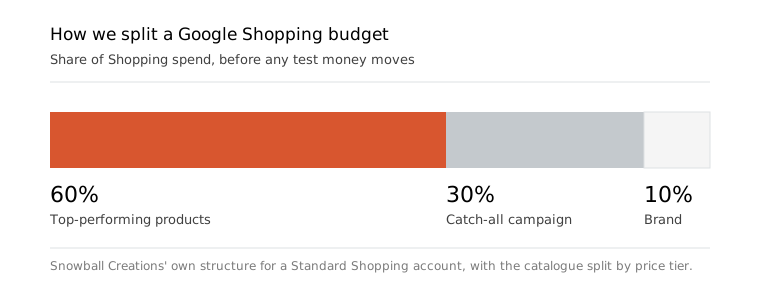
That split is ours rather than an industry benchmark: roughly 60% of Shopping budget behind top-performing products, about 30% in a catch-all campaign and about 10% on brand, with the catalogue divided by price tier so a £90 lamp is not competing for budget with a £2,400 sofa. Ask any agency for theirs. If the answer is that the algorithm decides, you are being sold automation rather than management, and it is worth reading our wider guide to Google Ads for e-commerce before you sign anything.
What Google Shopping management should cost
Nobody on this list except us publishes a price, which is normal in this trade, so here is ours in plain numbers. Our fees start at £1,749 per platform per month, on a three-month commitment and then one month’s rolling notice, and we ask for a minimum ad spend of £2,500 a month per platform.
The minimum spend is arithmetic rather than a sales gate. Below roughly that level a Shopping account does not gather enough data in a month to decide anything, so you would be paying a management fee to watch noise. Ask for the fee, the commitment length and the minimum spend in that order, and ask whether the fee changes as spend grows. If you are still weighing up whether to hire anyone at all, start there instead.
Picking one that suits your catalogue
Catalogue shape decides this more than agency size does. A 40-product furniture range with high order values needs someone who will work product by product; a 20,000-line kitchenware catalogue needs feed automation and someone who enjoys it; a brand whose real problem is the website should hire the people who can fix the website. If you want a wider view, we also keep lists of agencies running Google Ads for furniture brands and of marketing agencies for the homeware sector, plus a broader one on UK Google Ads agencies.
If you want the Shopping side run by people who do this for furniture and homeware every week, get in touch and we will look at the account first. If the answer is that you do not need us yet, we will say so, which is cheaper for everyone.
FAQ
Questions people ask
How long should I give Google Shopping before judging it?
Long enough to get through the testing stage, which in most accounts we run is months rather than weeks. Judge it on impression share and volume trends rather than one strong week, and never more than double an account's spend inside a single month to chase a good one.
Will an agency have to rebuild my feed if I use Shopify or WooCommerce?
Usually not. Internet Marketing Team's Google Shopping page, read on 23 September 2026, notes that products can be added automatically on platforms such as Shopify or WooCommerce. The work is then optimising what that export produces, particularly the product titles, rather than building a feed from nothing.
Is the 2,500 pound minimum ad spend per platform or across everything?
Per platform, per month. If you want Google Shopping and Meta running at the same time, that is a minimum ad spend of 2,500 pounds a month on each. It is a floor for gathering usable data rather than a target, and our fees are quoted the same way, from 1,749 pounds per platform per month.
Do I need separate people for the Merchant Centre feed and the campaigns?
No, and splitting them causes problems. Feed quality decides which auctions your products enter, so whoever manages bids needs to be able to change the product data. Three of the four other agencies here describe both feed work and campaign management on the pages read on 23 September 2026.
Can I keep my in-house team and use an agency for Shopping only?
Yes, and it is a common arrangement. What does not work is hiring an agency and then directing the method week by week. We take the brief, the margins and the commercial priorities from your team, and we would rather walk away than run an account to someone else's playbook.
Tagged
- best ad agencies