paid advertising · ad agency · ecommerce · ppc
Best PPC Agencies for E-commerce Brands (2026)
Five notable UK PPC agencies for e-commerce brands in 2026, what each one actually does, and how to judge a Shopping account before you sign.

If you sell physical products online and you are close to hiring a PPC agency, the thing worth judging is not size or client logos. It is who will open your Merchant Center on a quiet Tuesday and read the feed, the impression share and the search terms when nothing looks broken. Below are five UK agencies worth a conversation in 2026, ours included.
Snowball Creations is first because this is our list. The other four are small or lesser-known agencies, and every fact about them here was read off their own site on 21 September 2026. “Top” means notable and active, not ranked by quality: nobody can rank an agency they have never worked with. We have named them in plain text rather than linked to them.
The short version
- Snowball Creations: best for 7-figure homeware and furniture brands that want Shopping and Meta managed weekly, not reported monthly.
- Blink: a Norwich search agency that runs SEO and paid together, with Merchant Center feed work treated as core.
- Fly High Media: a Manchester agency with a named, small PPC team and feed work across Google and Bing.
- Wired Media: a Bristol agency that came up through web design, with sector pages for furniture, homeware and kitchenware.
- Whole Design Studios: a Shopify design and marketing agency for smaller stores that want the site and the ads from one team.
Snowball Creations
We are a paid ads agency for 7-figure SaaS, B2B and homeware e-commerce brands, founded in 2017, based in London and the south coast with the creative team in Cape Town. For a product brand that means Google Shopping and Search first, Meta beside it, and Microsoft, Amazon, TikTok or Wayfair as a slice. Our work with homeware and interiors brands is the closest fit to this list.
The setup is a fraction of the job. Weekly, monthly and quarterly lever checks on every platform are where the money is made, and that is what a client is paying for. Standard Shopping is the go-to, Performance Max runs beside it as an experiment split by price tier, and conversion tracking is in place before a pound is spent. Fees start from 1,749 pounds per platform per month, on a three-month commitment then one month’s rolling notice, with a minimum ad spend of 2,500 pounds a month per platform.
Why They’re a Good Choice
- Hairpin (UK furniture, Google Shopping): 8x ROAS, 5m pounds in sales from 627k pounds of ad spend over five years.
- Tom Raffield (furniture and lighting): Google Ads now their primary acquisition channel, 3m pounds in sales from 544k pounds at 5.5x since 2020.
- Trusted by 100+ 7-figure+ brands, with ad creative made in house rather than farmed out.
- Best for: brands already converting, with margin, that want the account managed weekly instead of built once.
Blink
Blink is a Shopify-focused search agency based in Norwich that sells SEO and paid search as two halves of one job. Its PPC page, read on 21 September 2026, says the team manages Google Ads across Search, Shopping and Performance Max, plus Meta Ads and Microsoft Ads, and that it concentrates on large-catalogue e-commerce brands.
The part that stands out is feed management. The page argues that many Shopify agencies treat Merchant Center as an optional extra rather than a separate platform with its own work, which matches what we usually find in an audit. It names the people doing it, with Jess Morgan as head of PPC supported by CTO Dr Ian Read and data scientist Dr Joshua Prettyman, and says tracking is part of the remit, including server-side tracking.
Why They’re a Good Choice
- Feed and Merchant Center work described as core rather than an add-on (blinkseo.co.uk, read 21 September 2026).
- Organic and paid search run by one team, with brand terms excluded where the two would overlap.
- Named specialists rather than an anonymous pod, and month-to-month working according to the same page.
- Best for: large-catalogue Shopify stores that want search handled as a single channel.
Fly High Media
Fly High Media is a Manchester agency founded in 2016 by managing director Matt Pyke, which its e-commerce PPC page (read 21 September 2026) says grew out of a university start-up. It has offices in Manchester and Cheshire, and sells SEO, PPC and paid social alongside web design.
For product brands the page lists keyword research, product feed optimisation across Google and Bing, campaign build, ad creative, conversion tracking and continuous testing. It describes an 80/20 execution model, prioritising the fifth of the work that produces most of the result, which is not far from how we think about scaling. The PPC team is named on the page: Mike Hayden as PPC manager, Annie Hilditch as PPC executive, with Rob Jeffries and Jess McMillan on client services.
Why They’re a Good Choice
- A regional team outside London, named on the page, which usually means you speak to the person doing the work.
- Product feed work that covers Bing as well as Google, which plenty of stores leave alone entirely.
- SEO, paid social and web design in the same building if you would rather have one supplier.
- Best for: stores that want a small hands-on team and are happy to start with a short call.
Wired Media
Wired Media is a Bristol agency, based at 2 Redcliffe Way, that came up through web design and development and now runs SEO, PPC and paid social alongside it. Its e-commerce PPC page, read on 21 September 2026, covers Google Ads, Microsoft Ads, Performance Max, display, remarketing and analytics, and the page states 25 years of experience and a UK-based team.
It is the closest on this list to the homeware world we work in: the site carries sector pages for furniture, homeware, kitchenware, jewellery and luxury brands, which suggests the team has handled premium catalogues before. Senior people are named, including Joel Green as head of PPC, Adam Taylor as managing director, Tom Beasley as founder and director and Saqib Akram as head of data, and the page offers a free discovery session.
Why They’re a Good Choice
- Sector pages for furniture, homeware and kitchenware brands (wiredmedia.co.uk, read 21 September 2026).
- Web design, development and conversion work in house, which helps when the product page is the bottleneck rather than the campaign.
- A named senior team, including a head of data, and one account manager per client.
- Best for: premium product brands in the south west that want the site and the ads under one roof.
Whole Design Studios
Whole Design Studios is a Shopify design and marketing agency founded in 2012, described on its Shopify PPC page (read 21 September 2026) as a fully remote business founded in London with a team working from more than ten countries. It runs Google and Meta campaigns alongside Shopify design and development, and its founder, Giles Thomas, is named on the page.
The offer is a fully managed service with nothing outsourced, according to that page, which also sets out the Shopping work in detail: product data accuracy, product grouping and bids set by product group. Communication is defined rather than promised, with fortnightly video calls, weekly update emails and a monthly report, and the plans are monthly rather than annual.
Why They’re a Good Choice
- Store build and ads from the same team, which shortens the loop when a product page needs changing.
- A stated reporting cadence instead of a vague promise to be transparent.
- Shopping feed and product-grouping work described specifically, not just listed as a service.
- Best for: smaller Shopify brands that want design, development and paid ads from one supplier.

How to choose an e-commerce PPC agency
Judge the boring parts. Ask what happens in week six rather than week one: who reads the search terms, who checks the feed and what gets turned off. In most accounts we audit the build is fine and the management is missing, which is why performance drifts after the first good month.
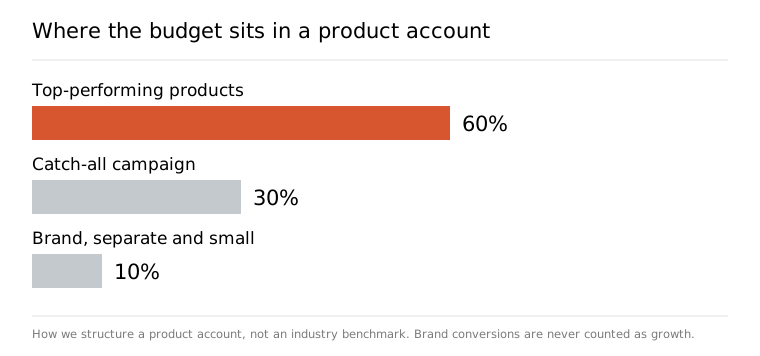
Then look at structure. On a product account we run, the money splits roughly three ways: about 60% behind the top-performing products, about 30% in a catch-all campaign for everything else, and about 10% on brand, kept separate and small. Brand conversions are never counted as growth. Standard Shopping stays the go-to and Performance Max runs as an experiment beside it rather than swallowing the account.
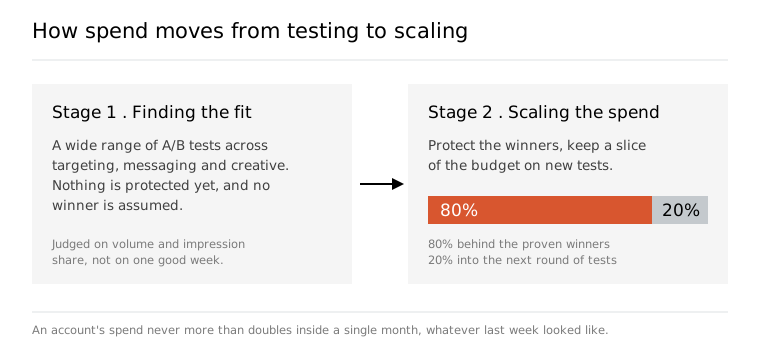
Finally, ask how they scale. There are two stages: finding the fit, which is a wide range of A/B tests across targeting, messaging and creative, and scaling the spend, where about 80% of the budget sits behind the winners and 20% keeps testing. An account’s spend never more than doubles inside a single month, because volume and impression share are what you scale on, not one good week. If an agency’s answer to a good week is to triple the budget, you have learned something. Our guide to Google Ads for online stores and the walkthrough of Merchant Centre cover the mechanics underneath.
What to ask before you sign
Four questions sort out most of it: who owns the accounts, what the weekly routine is, how ad creative gets made, and what happens if it does not work. Asked in that order, they separate a team that manages accounts from a team that builds one and moves on.
On Meta, ask about creative in particular, because for homeware creative is the main lever. A 45-day retargeting window and a progressive-discount carousel for warm audiences will do more than another afternoon of audience tinkering. When performance drops, the suspects in order are creative fatigue, frequency, budget jumps, stock-outs and toxic comments, so an agency that only ever reaches for bids is looking in one place out of five. Be wary of a platform rep’s advice too: it is written for the platform’s revenue, and in the accounts we have audited, trusting the algorithm has not worked out.
Price is the easiest question to ask and the hardest to get answered. Ours, plainly: fees from 1,749 pounds per platform per month, a three-month commitment then one month’s rolling notice, and a minimum ad spend of 2,500 pounds a month per platform. If you are still weighing up the options, we have written about the trade-offs between an agency, a freelancer and a hire, about whether an agency is the right move at all, and about why the cheapest clicks are rarely the profitable ones.

Where we would start
If you sell premium homeware or furniture and the site already converts, start with Shopping and Search, get tracking and the feed right before adding platforms, and choose the agency whose answer to “what happens in week six” is specific. Any of the four above could be that agency, and so could we. Our furniture and interiors work is where this method gets used most.
If you would rather see the account first, our free audit is the honest way to find out whether we would help. Tell us what you sell and what you are spending, and we will say plainly if ads are not the problem: get in touch.
FAQ
Questions people ask
Who should own the Google Ads and Merchant Center accounts?
You should. Your company creates the accounts and gives the agency access, so that when the relationship ends you keep the history, the conversion data and the feed rules. An agency that will only work inside its own account is asking you to leave your learning behind when you leave.
What is the smallest ad spend worth starting with?
We ask for a minimum ad spend of 2,500 pounds a month per platform, because below that a Shopping account gathers data too slowly to make decisions on. That is separate from fees, which start from 1,749 pounds per platform per month.
How long should the first contract be?
Long enough to see a full testing cycle and no longer. Ours is a three-month commitment, then one month's rolling notice. Terms differ: Blink's PPC page, read on 21 September 2026, says it works month to month rather than on long contracts, so ask each agency directly.
Can one agency run both Google and Meta, or do I need two?
One is usually better, because the two platforms feed each other and splitting them means nobody owns the overall number. What matters is that the agency treats them differently: search captures demand that exists, while Meta creates it, and judging both on last-click alone will make Meta look worse than it is.
Does paid search work if I only sell ten products?
Yes, though the structure changes. With a small range there is little point in a large catch-all campaign, so more of the budget sits on the products that convert and on search terms around them. The risk with a small range is not structure but margin, which is worth checking before you spend.
Tagged
- best ad agencies