paid advertising · google ads · facebook ads · ecommerce
Too Reliant on Meta Ads? How to Add Google Safely
Most of your revenue comes through Meta and every wobble hurts. How we add Google Shopping and Search beside it without breaking what already works.
Published

Key takeaways
- Don’t cut Meta to pay for Google. Add Google with new money and leave the Meta campaigns that work exactly as they are.
- Get Google’s conversion tracking right before a pound is spent, and judge both platforms on the revenue in your own shop’s back office, not on what each one claims.
- Start with Standard Shopping and a small, separate brand campaign. Performance Max comes later, as an experiment beside Shopping, split by price tier.
- Never more than double Google’s spend inside a month. The aim is a second channel that holds when Meta has a bad week, not a replacement for Meta.
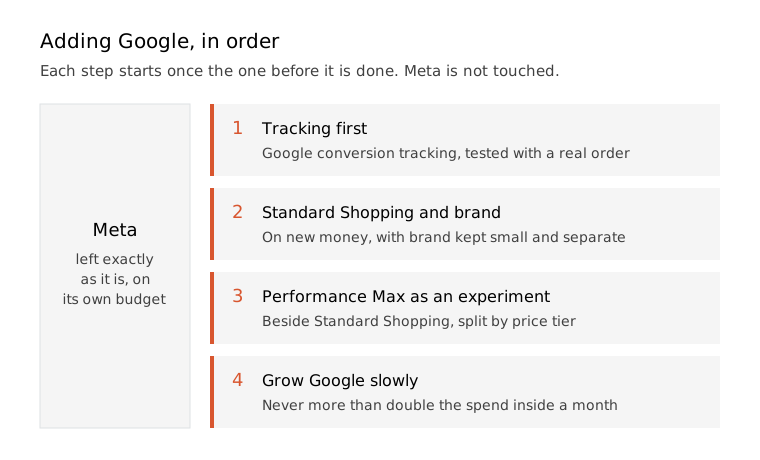
If nearly all your revenue arrives through Meta, the fix is not to move money out of Meta. It is to add Google beside it, carefully and with fresh budget: tracking first, then Standard Shopping and a small brand campaign, then Performance Max as a controlled experiment, growing Google’s spend by no more than double in any month. Meta keeps doing what it does well, which is finding people who didn’t know they wanted your sideboard. Google starts catching the people already searching for one.
That is how we add Google for the homeware and furniture brands we work with, most of whom arrive with a Meta account that is doing fine and a founder who sleeps badly every time the cost per purchase jumps.
Why relying on Meta alone feels so fragile
Relying on Meta feels fragile because one platform is doing two jobs: creating demand and capturing it. When a creative tires or the auction gets pricey, both jobs wobble at once and revenue drops with nothing underneath it. Google spreads that risk because it reaches a different buyer, the one who is already searching.
Meta is very good at putting a product in front of someone who wasn’t looking for it. That is a real skill, and plenty of premium homeware brands are built on it. But a good share of the people who see your ad on Instagram go away, measure the alcove, show their partner and then type your brand name, or “oak sideboard”, into Google a fortnight later. If you aren’t there, somebody else is, quite possibly with a cheaper sideboard.
So the question is rarely “Meta or Google?”. We covered that comparison in Google Ads vs Facebook Ads, and for most premium e-commerce brands the honest answer is both. The question here is how to add the second without breaking the first, which is about order and patience far more than about platforms.

Leave the Meta account alone while you add Google
Fund Google with new money and leave Meta untouched while Google beds in. The most common mistake we see is a founder trimming Meta by a third to “pay for” Google, which knocks the working account off balance in the same month the new one is still finding its feet. Two experiments at once means you can’t tell which one hurt you.
A healthy Meta account is in what we call Stage 2, scaling the spend: the winners are known, about four-fifths of the budget sits behind them and a fifth goes into new tests. That shape took months to find, and it is the thing paying your wages. Google, meanwhile, starts at Stage 1, finding the fit, with its own budget and its own tests. Keep the two stages apart and each one tells you the truth.
If Meta does dip during the build, check the usual five suspects in order (creative fatigue, frequency, budget jumps, stock-outs, toxic comments) before blaming Google. We go through each of them in Meta ads for homeware and furniture brands. In our experience the dip usually has nothing to do with the new channel at all.
Fix tracking before a pound goes into Google
Set up Google’s conversion tracking, tested end to end with a real order, before any campaign goes live. A Google account that can’t see sales is bidding blind and learning from nothing. Then agree, before launch, that both platforms will be judged on the revenue in your own shop’s back office rather than on the numbers each platform reports about itself.
This matters more for a Meta-heavy brand than for anyone. Meta will claim a share of sales that began with a Google search, and Google will claim sales that began with an Instagram ad. Add the two dashboards together and you will usually have “sold” more than you banked. The founder who reads both at face value either panics or celebrates, and both are premature.
What we watch instead is plain: total revenue, total ad spend across both platforms, and new customers. If Google is working, the total goes up while Meta’s own numbers hold steady. If the total stays flat while Google claims a pile of sales, it is mostly taking credit for buyers Meta, or your brand name, was already bringing in.

Start with Standard Shopping and a small brand campaign
For a homeware or furniture brand, the first Google campaigns should be Standard Shopping, plus a small brand campaign kept separate from everything else. Shopping puts the product photo and price in front of someone searching for exactly that item, which is the buyer Meta has been warming up for you. Performance Max can wait.
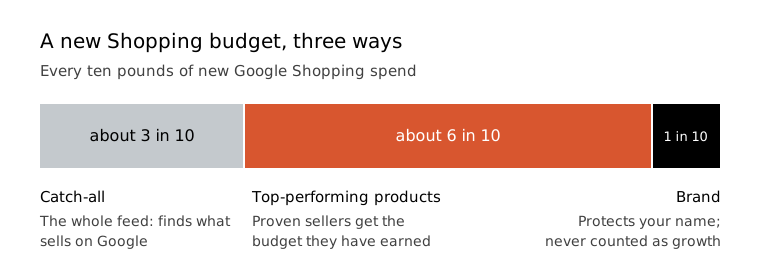
We split a new Shopping budget three ways. A catch-all campaign holding the whole feed takes roughly three pounds in every ten, a campaign for the top-performing products takes about six in ten, and brand takes about one in ten. The catch-all is where you discover which products sell on Google, and they are often not the ones that sell on Meta. The top-products campaign gives the proven ones the budget they’ve earned, and brand protects your own name. Brand sales are never counted as growth, because those people were looking for you already.
Alongside Shopping, a Search campaign on the product terms people actually type catches the buyers who search in words rather than pictures. We run it on phrase match by default and exact match for brand, almost never broad (our guide to keyword match types explains why). If your product feed is a mess, fix that first: the Google Merchant Centre tutorial walks through it.
Where Performance Max fits
Performance Max comes in once Standard Shopping has a few weeks of clean data, as an experiment running beside it rather than a replacement. We split it by price tier, so the algorithm isn’t free to spend most of the budget on cushions while the expensive sofas sit unseen. If it beats Standard Shopping on the same products, it earns more budget; if it doesn’t, it stays small. Our longer verdict is in is Performance Max good?.
Grow Google slowly: never more than double in a month
Once Google is making sales at a cost you’re happy with, increase its spend by no more than double inside any single month. Scale on impression share and volume, not on one good week. A furniture buyer takes weeks to decide, so a strong week on Google is often last month’s Instagram ads paying out, and a budget that leaps on the strength of it usually falls straight back.
Doubling slowly sounds timid until you’ve watched the alternative. An account that jumps from a test budget to several times that in a fortnight starts buying the broad, half-interested clicks it had been avoiding. The cost per sale climbs, and the founder concludes that Google doesn’t work for their brand. It did work. It was simply fed faster than it could find good buyers.
What to check every week while Google beds in
The setup is a fraction of the job; the weekly checks are where a second channel either earns its place or quietly wastes money. For the first three months, these are what we look at every week on the new Google account, alongside the usual Meta checks:
- Search terms: what people actually typed before they clicked, and which of them to exclude.
- Product performance in the catch-all, so winners move into the top-products campaign.
- Impression share on brand and top products, which tells you whether there is room to grow.
- Total revenue against total spend across both platforms, read from the shop rather than the dashboards.
- Meta’s own cost per purchase, to make sure the channel that pays the bills hasn’t been disturbed.
None of this is clever. What makes it work is that someone does it every week, rather than once at launch and again when the numbers go wrong. A campaign nobody checks is a campaign Google runs for itself, and Google’s idea of a good month isn’t always yours. Patience is how a second channel ends up carrying real weight: for Tom Raffield, the furniture and lighting brand, Google Ads is now their primary acquisition channel.

Your plan for the next three months
If Meta is carrying the whole business, this week’s job is not a new campaign. It’s tracking: get Google’s conversion tracking working and tested, and agree that the shop’s own revenue is the scoreboard. Next comes Standard Shopping with the three-way split and a small brand campaign, on new money. Then Performance Max as an experiment by price tier, and growth of no more than double a month. Meta stays exactly as it is throughout, which is rather the point.
For the build itself, our guide to Google and Facebook ads for e-commerce goes campaign by campaign, and the Google Ads guide for e-commerce covers the Google side in more depth. If you’d rather someone else did the weekly work, it is exactly what our homeware and furniture paid ads team and Google Ads management do.
Want a second pair of eyes first? Ask for a free account audit and we’ll tell you honestly whether Google is ready for you, and whether you’re ready for Google.
FAQ
Questions people ask
Do we need Google Merchant Centre before running Shopping ads?
Yes. Google's own help page on Shopping ads (read 16 November 2026) says they use your Merchant Center product data rather than keywords to decide where to show, and are managed through Shopping or Performance Max campaigns. So the feed is the foundation: the titles, images and prices in Merchant Centre decide which searches you appear for.
How long does a new Google campaign take to settle?
Google's help page on Smart Bidding learning (read 16 November 2026) says the Learning status never lasts more than seven days, ads serve as normal meanwhile, and budget changes do not trigger it. We still judge a new campaign over a full buying cycle, which for furniture usually means weeks rather than days.
Which platform gets the credit when a customer clicked ads on both?
Each platform credits itself. Inside Google Ads, data-driven attribution is the default model for most conversion actions and shares credit across your Google ad interactions, while last click is still available (Google Ads Help, read 16 November 2026). Neither platform sees the whole journey, so neither report is the final word.
How much do we need to spend to add Google properly?
We work to a minimum ad spend of £2,500 a month per platform, so Google needs at least that on top of Meta's budget, not carved out of it. Our fees from £1,749 per platform per month come with a three-month commitment, then one month's rolling notice.
Should we add Microsoft Ads or TikTok at the same time as Google?
Not at the same time. One new channel at a time is the only way to know what each one did, for the same reason we leave Meta alone while Google beds in. Once Google is stable and growing within the doubling rule, Microsoft Ads or TikTok can be tested as a smaller slice.