paid advertising · ad agency · ppc · saas
Who Actually Runs Your Paid Ads Account?
Who really does the day-to-day work when you hire a paid ads agency, how to check seniority before you sign, and the questions that get a straight answer.

The short version
- Ask who will be in your account by name, before you sign anything. In the pitches I have sat in, the people who win the work and the people who do it are often not the same people.
- The job is not the build. It is the weekly, monthly and quarterly checks on each platform, and whoever does those is the person running your account.
- Seniority earns its money at two moments: when you scale spend, and when performance drops and somebody has to work out why.
- A less experienced person doing the checks with someone senior reading the output is a fine setup. A less experienced person alone with your budget is not.
- All of this fits in one email before you sign, and how fast the answer comes back tells you plenty.
Ask for names, and ask how often those names will be inside the account. That is really the whole question. Winning work and running accounts are two different skills, agencies staff them accordingly, and nobody mentions it unprompted because the conversation is awkward. You are entitled to know who you are getting, how senior they are, how many other accounts they carry and who reads their work. If the answer is vague while they are still trying to sign you, it will be vaguer in month four. The decision about whether to use an agency at all is a separate one, and worth making first.
Who is in your account day to day
Usually one named person does the hands-on work, a second pair of eyes reviews it on a cadence, and a creative specialist makes the ads. What you want to establish is which of those three exist at the agency in front of you, which of them you will ever speak to, and whether any of them was in the room when you were sold the plan.
Job titles are no help. “Account manager” can mean the person optimising your campaigns or the person forwarding your emails to the person optimising your campaigns, and both are common. The cleaner test is to ask what that person will actually do on a Tuesday, in verbs. Someone who runs accounts will tell you about search terms, negatives and budget pacing. Someone who manages the relationship will tell you about reporting and comms, which is a real job but not the one keeping your cost per acquisition down.
The same question decides the shape of the whole choice. A freelancer is one person with no second pair of eyes, an in-house hire is one person with no other accounts to learn from, and an agency is meant to be several people with a method, which only matters if those people are genuinely in your account. That trade-off is worth reading in full in our piece on agency, freelancer or in-house.
Why the person who pitched you is rarely the person in the account
Because selling and delivering are different jobs. The founder or head of growth is usually the best communicator in the building, so they take the calls; the account then moves to whoever has capacity. That is not dishonest on its own, and I have written before about what running an ads agency looks like from the inside. It becomes a problem in two specific ways.
The first is the quiet handover. The plan you bought was built by someone who understood your margins and your sales cycle, and the person who inherits it has a document and a login. The second is the drift afterwards. Nobody announces that your account has been reassigned twice since you signed, and you only find out when you ask a question in month five and the reply reads like it came from someone meeting your business for the first time. Ask, at the point of signing, to be told in writing when the person on your account changes. It costs them nothing to agree, and agreeing to it changes how carefully they staff you.

What the day-to-day work actually is
Checks, on a cadence. The build happens once and the setup is a fraction of the job: conversion tracking including offline conversions back to your CRM, campaign structure, phrase match by default with exact match kept for brand. After that, the money is made or lost in the weekly, monthly and quarterly lever checks, and that is what a management fee is really buying.
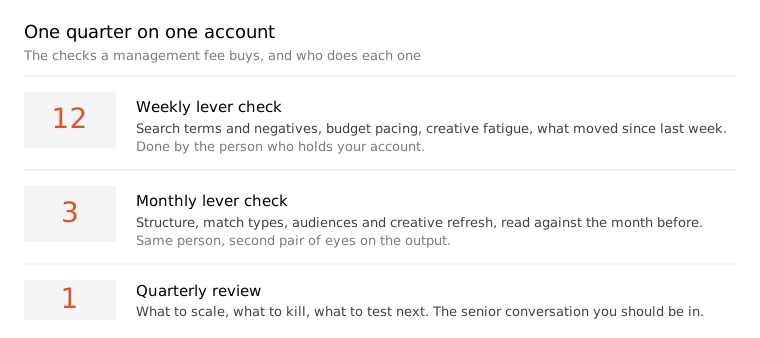
Over three months that is twelve weekly checks, three monthly ones and one quarterly review. The weekly pass is unglamorous and it is where the waste is caught: search terms and negatives, budget pacing, creative fatigue, what moved since last week and why. The monthly pass steps back to structure, match types, audiences and creative refresh. The quarterly one is the strategy conversation about what to scale, what to kill and what to test next, and you should be in it rather than reading about it later. If a prospective agency cannot describe its own cadence, there probably isn’t one, and a campaign nobody checks is a campaign the platform runs for its own benefit. We lay out the whole management picture in paid media management, simplified.
Where seniority actually matters
At two moments, and they are both expensive to get wrong. The first is scaling. We never more than double an account’s spend inside a single month, and we scale on impression share and genuine volume rather than on one good week, because a budget doubled on a fluke takes a quarter to unwind. The second is diagnosis: when Meta performance falls over, the suspects in order are creative fatigue, frequency, budget jumps, stock-outs and toxic comments, and knowing that order is the difference between a fix on Thursday and a month of guessing.
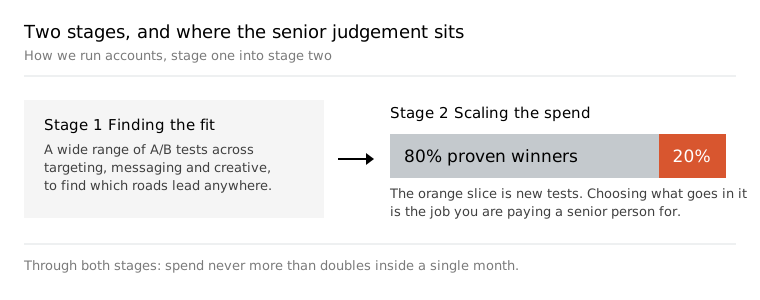
It shows up in the two stages too. Stage one is finding the fit, a wide range of A/B tests across targeting, messaging and creative. Stage two is scaling the spend, with about 80% protecting the proven winners and about 20% going into new tests. Choosing what sits in that 20% is judgement, not admin. The same applies to the platform’s own advice: reps ring every week with recommendations written for the platform’s revenue, and someone has to be senior enough to audit that rather than click accept, which is a habit we unpick in more detail.

Three questions that get you a straight answer
Keep it to three, and ask them before the contract rather than after. They are easy to answer honestly and awkward to answer evasively, which is the point.
- Who, by name, will be in my account each week, and can I have fifteen minutes with them before I sign? A good answer is a name, a role and a calendar invite.
- What happens in a weekly check, and will I see the output? A good answer is specific and a little boring. A list of nouns like optimisation and performance is not an answer.
- How many other accounts does that person hold, and what happens when they are away or they leave? Everyone has holidays and some people resign. The agencies worth hiring have thought about it.
Listen for the plural, too. If every answer is “we”, ask who “we” is this week. And if you already have an agency and you are reading this to work out whether yours is doing the work, the honest test is in the numbers rather than the rapport: our guide on knowing whether your paid ads are working is the place to start.
Who runs your account at Snowball
Us, by name, which is the only reason this article is comfortable to write. I am still in client accounts; Daniel Jones and Miku Smith run paid ads alongside me; Joshua Sharpe heads creative, so the ads themselves come from Snowball Studios rather than from a stock template. We stay small deliberately, because the cadence above only works if the person doing it has the time to do it properly.
Fees start from £1,749 per platform per month, and what that pays for is the weekly, monthly and quarterly work rather than the build. Stefan at Testpad described what he got from us as “a scientific approach that drills into what does and doesn’t work”, which is a fair summary of what a cadence buys you. If you are a software business, the detail of how we work is on our SaaS paid ads page; if you sell furniture, lighting or home products, the homeware equivalent covers the same ground for Shopping and Meta.
What to settle before you sign
Get three things in writing: the names of the people who will be in the account, the cadence they will work to, and a promise to tell you when either changes. None of that is a big ask, and an agency that resists it is telling you something useful at no cost to you. Everything else in a pitch deck is easier to produce than a Tuesday afternoon spent in your account.
If you would like a second opinion on who has been working in your account lately, send us the details and we will take a look at it properly.
FAQ
Questions people ask
Can I meet the person who will run my account before I sign?
Ask for it, and treat a no as an answer in itself. We do not keep a separate pitch team, so the people on your first call are the people who will be in the account. Any agency can arrange a fifteen minute call with the person doing the work.
What happens to my account if the person running it leaves?
Ask whose name the ad accounts are in. We ask every client to own their own Google, Meta and LinkedIn accounts and give us access, so a change of hands is a permissions change rather than a rebuild, and your history, conversion tracking and audiences stay where they are.
Does a bigger agency mean more people working on my ads?
Not reliably. Headcount tells you how many accounts the agency can take on, not how many hours yours gets. The useful questions are how many named people touch your account, how often, and how many other accounts each of them holds.
How long am I committed to if the staffing changes?
Ours is a three-month commitment, then one month's rolling notice. Three months is roughly the time it takes to finish testing and read the results honestly, and after that you should be staying because the numbers are good, not because of a contract.