paid advertising · ad agency · saas · ecommerce
The First 90 Days With a New Paid Ads Agency
What should happen in your first 90 days with a paid ads agency: tracking, testing, the checks at day 30, 60 and 90, and the red flags at each.
Published

Key takeaways
- The first 90 days with a new paid ads agency are for tracking, building and testing. Scaling comes after, if the tests earn it.
- Conversion tracking, including offline conversions back to your CRM, should be working before a pound of your money is spent.
- Judge each month on work you can see rather than a promised number: a written test plan by day 30, a change log by day 60, a clear recommendation at day 90.
- Spend should rise in steps, never more than doubling inside a single month.
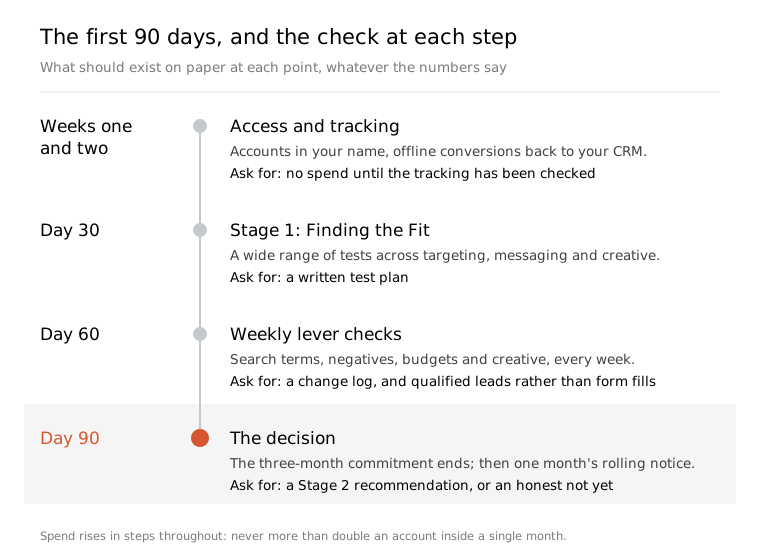
In the first 90 days with a new paid ads agency, three things should happen, in this order. Weeks one and two set up access and conversion tracking, so the account measures qualified demos or real orders rather than form fills. Month one launches a deliberately wide set of tests across targeting, messaging and creative. Months two and three read those tests, cut the losers and decide whether anything has earned more budget. What nobody honest can give you is a date by which the results arrive; what you can ask for is a timetable of decisions.
Our own terms are a three-month commitment, then one month’s rolling notice, so these are the 90 days we’re judged on too. If you’re still deciding whether to hire anyone, start with should I use a paid ads agency. If you’re comparing proposals, read the red flags to check before you sign first.
Weeks one and two: access and tracking before any spend
The first fortnight should produce very few ads. It should produce access to your accounts in your own name, conversion tracking you’ve watched fire, and an agreed definition of what a good conversion is. Quick onboarding is a virtue for paperwork, not a reason to launch before tracking works.
For SaaS and B2B, the definition is the whole game. Students, job seekers and free-tool hunters fill in forms too, and an account told to chase raw conversions will cheerfully buy more of them. How we run accounts: optimise towards qualified demos and paying users, with offline conversions sent from your CRM back to the platforms, set up before any money goes out. More in the importance of qualified SaaS leads.
Long sales cycles need one extra decision in this fortnight. Google’s help page on fixing offline conversion import errors (read 4 November 2026) says it only keeps the click ID, the GCLID, for 90 days, and recommends uploading a different, earlier conversion event when the sale lands after that. So if your deals take longer than three months to close, agree in week one which stage of the pipeline gets sent back, usually the qualified demo rather than the signed contract.
For homeware and furniture brands, the equivalent is the product feed: margins by product, which lines you want pushed, which are low on stock. The red flag at this stage is campaigns live on day three with tracking “to be sorted later”. Our pre-launch checklist for paid ads covers the rest of what should be in place.

Month one: a wide test, on purpose
Month one is Stage 1 of the way we run accounts, Finding the Fit: a wide range of A/B tests across targeting, messaging and creative, to see which roads lead anywhere. Expect the account to look busy and a little untidy. That’s the point, and why month one is the wrong month to judge anybody on.
What gets tested depends on the platform. On Google Search we default to phrase match, use exact match for brand and almost never use broad, and the brand campaign is kept separate and small so that people who already know you aren’t counted as growth. For homeware, Standard Shopping comes first and Performance Max runs beside it as an experiment, not instead of it. For B2B, LinkedIn is there to create the demand Google later converts, so it never runs on its own.
By day 30 you should be able to ask for a written test plan and get one. It doesn’t need to be long, but it should answer these:
- What is being tested on each platform, and why that first?
- What result would make each test a winner, and over how much volume?
- Which conversion is each campaign optimising towards?
- Who opened the account this week, and what did they change?
If nobody can say what is being tested, the account is running on instinct or the platform’s defaults, and neither is what you hired.
Month two: the weekly checks start to show
By month two the setup is done and the job becomes the weekly, monthly and quarterly lever checks. You should be able to see it: search terms read and negatives added, losing ads paused, budget moved towards what’s working, products that stopped selling pulled out of the spend.
So ask for a change log rather than a prettier dashboard: what changed, when and why tells you more than a chart of clicks. The report itself should lead with qualified leads, demos or orders, with brand reported on its own line. To sanity-check them yourself, here’s how to know if your paid ads are working.
The red flags at day 60 are easy to spot: a report that’s all clicks and click-through rate, a conversions figure nobody can trace to your CRM, and a recommendation that is “increase the budget” every month. It’s also the moment to check who actually runs your paid ads account from day to day.

How fast should spend go up in the first 90 days?
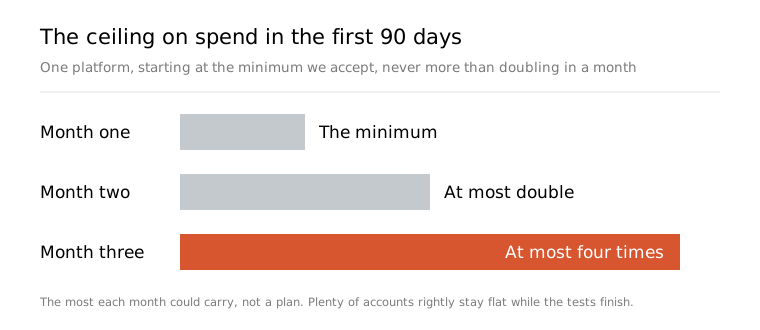
Slowly, in steps, and only when the numbers have earned it. Our rule is never to more than double an account’s spend inside a single month, and to scale on impression share and volume rather than on one good week. A strong fortnight in month two is a hypothesis, not a result.
Take an account starting at the minimum spend we accept on one platform. Under that rule the most it could carry in month two is double that, and in month three four times the starting point. That’s a ceiling, not a plan: plenty of accounts rightly stay flat while the tests finish, and nobody should steer you towards the top of it for its own sake.
A sudden jump pushes the platform into new auctions and new audiences faster than the data can follow, and on Meta a budget jump is one of the first suspects we check when performance drops, alongside creative fatigue, frequency, stock-outs and toxic comments. If an agency proposes tripling spend after a good fortnight, ask what it knows that the data doesn’t.
Day 90: the decision you are actually making
At day 90 the three-month commitment ends and the relationship moves to one month’s rolling notice. The question isn’t whether the account has hit a number. It’s whether Stage 1 has found something worth scaling, and whether you trust the people who found it.
If it has, Stage 2 is Scaling the Spend: protect the winners, put most of the budget behind them, and keep a smaller slice for new tests. The split we use is set out on our SaaS paid ads agency page. If it hasn’t, an honest agency says so and stays in Finding the Fit, which is a better answer than scaling something that only half works. The questions worth asking in that meeting:
- Which tests won, which lost, and what did each one teach you?
- Is the tracking reliable enough to scale on, and how do you know?
- What would Stage 2 look like: which campaigns get the money, and what gets tested next?
- If we stopped tomorrow, what would we keep? The answer should be every account, in our name, with its history.
If you ever do leave, here’s how to switch agencies without losing your account history.

What your side of the table owes the agency
The first 90 days go faster when the founder answers quickly. An agency can’t test creative you haven’t approved, track sales your CRM doesn’t record, or bid sensibly on margins nobody has shared. In most onboardings we’ve run, the slow bits sit on the client’s side of the table.
Hand over early: your margins and average order value or lifetime value, one named person who can approve ads within a day or two, access to the CRM or shop platform, and warning of anything that will move the numbers, such as a price change, a stock-out, a launch or a new website halfway through a test. On Meta, creative is the main lever for homeware, so tell the agency when a new product shoot is coming.
The other half is restraint. Give the agency the goal and the constraints, then let it run the method you hired. If you’re rewriting campaigns in week three, either the agency isn’t doing the job or you didn’t want an agency, and both are worth knowing early.
Judge the 90 days on decisions, not on a number
A good first 90 days doesn’t look like a hockey stick. It looks like tracking you trust by week two, a test plan by day 30, a change log by day 60 and a straight recommendation at day 90, with spend rising only as fast as the evidence. Those you can judge. A big number with none of them is something you can only hope about.
On Monday, ask your agency, or the one you’re about to sign with, for those three documents and see how quickly they arrive. If you’d like a second opinion on where your account stands, whether you’re 30 days in or about to start, book a free account audit and we’ll tell you what we’d do with it. Our work for homeware and furniture brands follows the same 90 days.
FAQ
Questions people ask
Who should be an admin on our Google Ads account during onboarding?
Someone at your company, ideally two people. Google's help page on access levels, read on 4 November 2026, shows that only admins can grant access, change access levels and unlink manager accounts, and warns that an account with a single administrator may lose access to its tags if that person becomes unavailable. The agency works through its manager account link.
What cost reporting is a Google Ads agency required to give us?
Google's third-party policy, read on 4 November 2026, says that where a monthly performance report is required it must include costs, clicks and impressions at account level, and that any cost data shared with you must be the exact amount Google charged, excluding the agency's own fees. An agency can also meet the requirement by letting you sign in to the account yourself.
Should the management fee be shown separately from the ad spend?
Yes. Google's third-party policy, read on 4 November 2026, requires an agency that charges a separate management fee to tell new customers in writing before the first sale and to disclose the fee on invoices. With us, the ad spend is billed by the platform inside your own ad account, and none of it passes through us.
Can we contact Google directly if we have concerns about our agency?
Yes. Google's third-party policy, read on 4 November 2026, requires agencies to give customers their Google Ads customer ID when asked, so that an advertiser can contact Google directly with concerns about a third-party partner. Ask for it in the first week and keep it somewhere other than the agency's inbox.
Should we start on one platform or several in the first 90 days?
Usually one. Most of our clients start on a single platform and add a second once the first is earning, because each platform is a separate job with its own build, creative and checks. Each one needs a minimum ad spend of £2,500 a month, and our fees start from £1,749 per platform per month.