paid advertising · ad agency · saas · ecommerce
How to Brief a Paid Ads Agency Properly
What to put in a paid ads agency brief so the first month isn't wasted: your numbers, the exact customer, the conversion, the history and the limits.
Published

Key takeaways
- A good paid ads brief fits on two pages and covers five things: what a customer is worth, who exactly you sell to, what counts as a conversion, what you’ve already tried, and the constraints.
- Give the agency the goal and the limits. Leave the method (match types, campaign types, bidding) to the people you’re paying for it.
- Write the conversion down before launch. Changing what the account optimises towards in week three puts the platform back to learning.
- Say how many leads or orders your team can actually handle. A brief that only says “more” gets more of the wrong thing.
To brief a paid ads agency properly, send two pages before the kick-off call that answer five questions: what a customer is worth and what you can afford to pay for one; who exactly buys, their problem and the one action you want from them; what counts as a conversion and where it’s recorded; what you’ve tried before; and the constraints, meaning budget, approvals, dates and capacity. Everything else is the agency’s job.
Most wasted first months we’ve seen weren’t caused by bad campaigns. They were good campaigns aimed at the wrong target, because nobody wrote the target down. What should happen once you’ve signed is in the first 90 days with a new paid ads agency; whether to hire anyone at all is in should I use a paid ads agency.
What a paid ads brief is actually for
A paid ads brief exists so the agency can make its first hundred decisions the way you would have made them, without asking you each time. It’s the goal and the limits, written down once. It isn’t a pitch deck about the company, or a campaign plan you’d like someone else to type in.
The test is simple. Could the person running your account read it on a Tuesday afternoon and decide, alone, whether to put more money behind a campaign bringing in cheap leads? If the brief says what a lead is worth and which leads count, yes. If it says “we want to grow aggressively across all channels”, they’re guessing, and they’ll guess in the direction the platform suggests.
The numbers: what a customer is worth to you
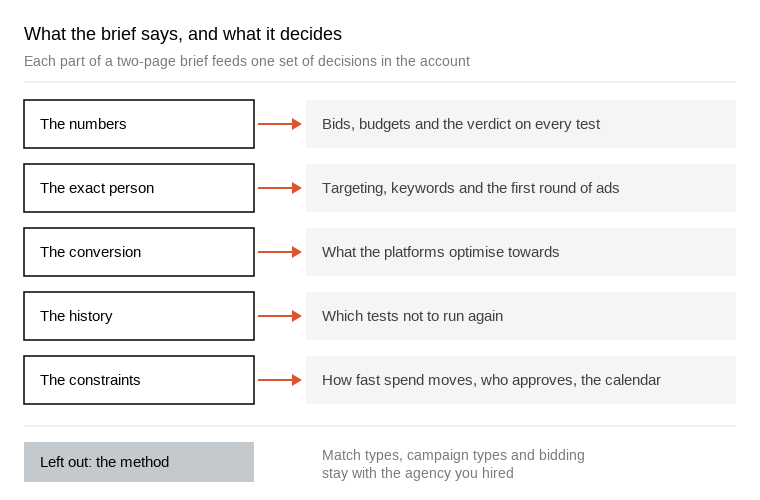
Start with the economics, because bids, budgets and the verdict on every test come back to them. For SaaS and B2B that means average contract value, lifetime value and the share of demos that become paying customers. For homeware and furniture it’s average order value, gross margin by product range and how often a customer comes back.
From those, give the one figure the agency will judge everything against: the most you can pay to win a customer and still be happy. A range you’d sign off is enough, and far more use than a ROAS target picked because it sounded respectable. If you’re unsure how to work it out, start with how to calculate customer lifetime value.
Be honest, even when the numbers are awkward. Tight margins, a low order value or a short lifetime are the usual reasons ads struggle, because a competitor who makes twice as much per sale can pay twice as much per click. We’d rather know on day one than find out in month three. It’s also why we’re upfront about the minimum ad spend we work with per platform: below it, a month doesn’t produce enough data to learn from.

The exact person, their problem and the one action
The creative half of the brief has one rule in the way we run accounts: name the exact person, their problem and the one action you want them to take. Not “SMEs” or “design-conscious homeowners”. A person with a job title, a budget and a reason to look today.
For a SaaS brief that might read: the operations manager at a 30-person logistics firm, still planning routes in spreadsheets, who we want to book a demo. For a furniture brand: a couple who’ve just bought a Victorian house and are furnishing the dining room, who we want to buy the table rather than pin it to a mood board. The agency turns that sentence into targeting, keywords and the first round of ads, so a vague sentence comes back as vague ads.
If you sell to more than one kind of buyer, list them in order of what they’re worth and say which one the first month is for. Two or three is fine. Seven means the brief is still a marketing plan. Our SaaS paid ads agency and homeware paid ads agency pages show who we usually build for in each sector.
What counts as a conversion, in writing
Write down which action counts as a win, where it’s recorded and how it gets back to the ad platforms. It’s the line most briefs skip, and an ad account optimises towards whatever it’s told is a conversion.
For B2B and SaaS, a form fill isn’t worth paying for on its own. Students, job seekers and free-tool hunters fill in forms too, and an account told to chase raw conversions will happily buy more of them. How we run accounts: optimise towards qualified demos and paying users, with offline conversions sent from your CRM back to the platforms before any money goes out. So the brief should name the CRM stage that means “qualified” and who decides it. More in the importance of qualified SaaS leads. For e-commerce the conversion is usually a purchase, but say which products you want sold and which you’d rather not push: low-margin lines, long lead times, anything about to run out.
Settle this before launch. Google’s help page About Smart Bidding learning (read 23rd November 2026) lists a significant change to the conversion goals as one of three things that put a bid strategy back into “Learning”. Moving the goalposts in week three doesn’t just annoy the agency. It resets the thing that was learning.

What you have already tried
Tell the agency what’s been tried before, including what didn’t work, and give them access to the accounts so they can see for themselves. That’s how they know which tests not to run again on your money.
Write a short history in plain sentences: which platforms, roughly what was spent, who ran them, what you think worked and what didn’t. Google’s page on reviewing your account history (read 23rd November 2026) says change history covers the last two years, filterable by user and by the tool used, which is usually more honest than anyone’s memory of what the last agency did.
Include the creative that won, too: old ads and the product photos that sold. If you’re moving from another agency, switching without losing your account history covers making sure that history comes with you.

The constraints: budget, approvals, calendar and capacity
The last part of the brief is the box the agency works inside: how fast spend moves, who approves the ads and what’s on the calendar. These facts change decisions week to week, and they’re easy to forget because they live in the founder’s head.
- Budget per platform per month, and how far it can move. We never more than double an account’s spend inside a single month, so say now if a bigger number is waiting behind a good result.
- One named person who approves ads, and how fast. A test can’t run on creative stuck in a committee.
- The calendar: launches, price changes, sales, a new website, the stock-outs you can see coming.
- Brand rules that actually matter: the claims you can’t make and the competitors you won’t bid against.
- Capacity: how many demos your sales team can take a week, or how many tables your workshop can make.
Capacity is the one left out most often. hubba’s co-founder Adrian Davies described the good version of the problem: “the constant supply of high quality leads has left us with only one problem. Growing our sales team!” Better to plan for that in the brief than discover it in the pipeline.
What to leave out of the brief
Leave out the method. The brief says where you want to go and what you can spend getting there; how the account is built is what you’re hiring the agency for, and it should stay with them. We take the brief, not the method.
So skip instructions like “use broad match”, “put everything into Performance Max” or “Advantage+ on every campaign”. They often come straight from a platform rep, and a rep’s advice is written for the platform’s revenue, as we’ve covered in why Google ad rep advice needs undoing. If you have a strong view on a tactic, put it in as a question (“we were told to try Performance Max, what do you think?”) and judge the agency on its answer.
Leave out most of the brand history, too, unless it explains who buys. Three paragraphs on the founding story don’t change a bid. One sentence on why customers choose you over the cheaper option might change every ad.
Two pages, sent before the kick-off call
A proper brief is two pages, sent a few days before anyone meets, so the first call is spent on questions rather than reading it aloud. Five parts: the numbers, the exact person, the conversion, the history, the constraints. The method stays with whoever you hired.
On Monday, open a blank document and write the first section, the most you can pay to win a customer. If that takes an afternoon of digging, it was the most useful afternoon of the whole hire. Then watch what comes back from the agency: good ones reply with questions about your numbers, not compliments about your brand.
If you’d like us to read your brief and your account side by side, book a free account audit and we’ll tell you what we’d change first.
FAQ
Questions people ask
Should our brief give the agency a target CPA to put into Google's bidding?
Give the agency the most you can afford per customer, and let it decide whether that becomes a bid target. Google's help page on Target CPA bidding, read on 23rd November 2026, says you set a desired average cost per conversion, that conversion tracking has to be set up first, and that you should be comfortable spending up to two times your average daily budget on a given day.
Can we give the agency our customer list for targeting?
Usually, with care. Google's Customer Match policy, read on 23rd November 2026, only allows data you collected first-hand from your own customers, and asks that your privacy policy says you share customer data with third parties who perform services on your behalf. Full targeting with a list is reserved for accounts with 90 days of history and a lifetime spend threshold Google sets in US dollars.
What access should we give an agency on LinkedIn?
LinkedIn's help page on Campaign Manager roles, read on 23rd November 2026, lists five: billing admin, account manager, campaign manager, creative manager and viewer. Every ad account must have a billing admin, and only that role can change billing details, so keep it with someone at your company and give the agency account manager or campaign manager access.
Will editing the ads after launch reset what a Google campaign has learned?
No. Google's help page on Smart Bidding learning, read on 23rd November 2026, says changes to budgets, targets, creative or targeting settings never remove historical data or trigger a Learning status. New or edited ads still have to pass Google's policy review before they serve, so allow for that when a launch date is tight.
Who at our company should write the brief?
Whoever owns the revenue number, usually the founder or the marketing head, with an hour from finance for the margins and an hour from sales for the lead definition. If the brief is written by someone who cannot approve a budget change, the agency ends up waiting on exactly the decisions the brief was meant to settle.